

The Best Iron Removal Plant in Adambakkam Chennai – 2024 is essential for treating groundwater that contains high levels of dissolved or precipitated iron. Iron is considered an objectionable constituent in potable water, as it imparts a metallic taste, produces oxidized precipitates, and causes visible discoloration. As a result, the water may appear yellowish-brown or reddish-brown, making it unpleasant and unsuitable for domestic or industrial use.
In addition, iron stains bathroom fittings, tiles, pipelines, storage tanks, and any surface it comes in contact with. Over time, this leads to corrosion, reduced appliance life, and increased maintenance costs.
Iron in water generally exists in two primary forms:
Ferrous Iron (Fe²⁺) – a bi-valent, soluble form that remains invisible in water but oxidizes when exposed to air
Ferric Iron (Fe³⁺) – a tri-valent form that typically appears as a precipitated rust-colored particle
The ferric form is usually found in suspended or precipitated condition and is easily noticeable.
Iron may also form complexes with various inorganic compounds such as:
bicarbonates
sulphates
phosphates
cyanides
halides
Furthermore, the presence of organic substances encourages the formation of iron-organic complexes, which increases iron solubility and makes removal more challenging. Generally, waters with higher alkalinity contain lower iron concentrations, whereas low-alkalinity water tends to have higher iron levels.

To level the pH factor, chemical pre treatment is done in order to facilitate rapid aeration, than the chemical dosed water send in to the aeration tanks.
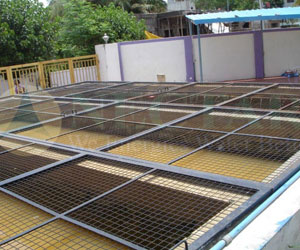
Chemical dosed water is send into the aeration tank consisting three chambers. The raw water is allowed to sprinkle at the first chamber through specially designed perforated pipes. The water travels from first chamber to other two chambers through accurately designed multiple vents at variable levels of the bifurcate walls, thus provides ZIG ZAG motion. When the water reaches the third chambers the dissolved iron gets oxides and become suspended iron particles.
Chemical dosed water is pumped in to aeration tank. The raw water is allowed to sprinkle (at the tank/sump) through specially designed perforated pipes and allowed to remain there for about 8 to 10 hrs to get oxidized through the natural process and the iron presence in the water becomes suspended iron.
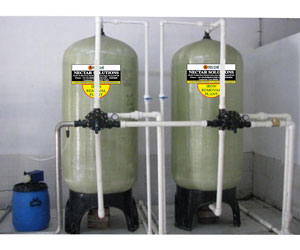
The suspended iron water is passed through Iron removal unit, the filter media is supported on gravel bed that consists of multiple layers of progressively larger sizes of Manganese Di oxide, Activated Carbon 900 IV, Graded quartz sand, Fine sand, Super fine white sand and Pebbles, which retain the suspended iron particles. During the filtration cycle the filter bed retains the dirt and suspended iron particles from the water and accumulates within the filter bed.
As the filtration progress, the filter media gets loaded with the retained particles. This results in a continuous increase of pressure drop across the filter.When a predetermined pressure drop level is achieved, the filter is shut down for cleaning. After backwashing, the filter media is rinsed with raw water (or) treated water. Once quality of water is achieved the filter is put back into service (filter).
Our NONFERR iron removal plants are comprises of Mild Steel /SS / FRP Pressure Vessel, Frontal piping wok with manual / Automatic multi port valve / Butterfly valve / conventional valves for easy operation and control, Iron remove plants are available from 1000 Liters/hr. to 10,00,000 Liters/day.




WEBSITE DESIGN AND MAINTAINED BY CLEMENCE WEB SOLUTIONS