

Nectar Solutions provides the Best Iron Removal Plant in Beemannapettai Chennai – 2024, delivering advanced iron removal systems, reliable water treatment, and affordable installation for homes, apartments, and industries.
Furthermore, iron acts as an objectionable constituent in potable water and directly affects overall water quality. When iron levels rise, the water develops a bitter metallic taste and immediately becomes unsuitable for drinking and daily household usage. In addition, oxidized iron produces visible precipitates and creates yellowish-brown to reddish-brown coloration, and as a result, users find the water unacceptable for domestic, commercial, and industrial applications.Best Iron Removal Plant in Beemannapettai Chennai – 2024
Moreover, iron deposits leave stubborn stains on sinks, tiles, pipes, sanitary fittings, fabrics, and storage tanks. Consequently, households and industries face frequent maintenance issues, higher cleaning requirements, and premature equipment damage.
Iron generally occurs in water in two major forms:
Ferrous Iron (Fe²⁺) — remains soluble and colorless in water
Ferric Iron (Fe³⁺) — appears in oxidized and precipitated form
Additionally, Ferric Iron often develops as suspended particles or solid deposits inside pipelines and storage tanks. Meanwhile, iron reacts with bicarbonates, sulfates, phosphates, cyanides, and halides, and consequently forms complex hydroxides and inorganic compounds. Furthermore, when organic substances are present, they create organic complexes that increase the solubility of iron.
Interestingly, water with higher alkalinity usually contains lower iron content. However, low-alkalinity water tends to retain more dissolved iron, and therefore increases the chances of staining, corrosion, and pipeline deposits.

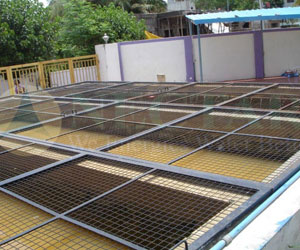
To level the pH factor, we first carry out chemical pretreatment to support rapid aeration. After dosing the raw water with chemicals, we then transfer it into the aeration tank, which consists of three chambers. First, the treated water sprinkles into the initial chamber through specially designed perforated pipes. Next, as the water moves forward, it flows from the first chamber into the remaining two chambers through accurately designed multiple vents positioned at variable levels along the bifurcated walls. Consequently, this zig-zag flow pattern increases aeration and significantly improves oxygen contact time.
Moreover, the extended aeration process allows dissolved iron to react with oxygen more effectively. As the water finally reaches the third chamber, the dissolved iron oxidizes and gradually converts into suspended iron particles. Therefore, the system improves iron removal efficiency and prepares the water for the next stage of filtration.
We pump the chemically dosed water into the aeration tank and allow it to sprinkle through perforated pipes for about 8 to 10 hours. During this period, the water undergoes natural oxidation, and the dissolved iron converts into suspended iron.
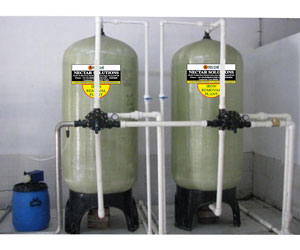
After aeration, we pass the suspended-iron water through the Iron Removal Unit. The filter media sits on a gravel bed with multiple graded layers of Manganese Dioxide, Activated Carbon (900 IV), graded quartz sand, fine sand, super-fine white sand, and pebbles. As a result, these layers effectively retain suspended iron particles and other impurities during the filtration cycle.
As filtration continues, the filter media gradually loads with retained particles, which in turn increases the pressure drop across the filter. Once the system reaches the predetermined pressure level, we shut down the filter for cleaning. Then, we perform backwashing to remove accumulated dirt and suspended particles. After backwashing, we rinse the filter media with raw or treated water, and once the desired water quality is achieved, we place the filter back into operation.
Furthermore, our NONFERR Iron Removal Plants feature Mild Steel, Stainless Steel, or FRP pressure vessels along with frontal piping, manual or automatic multi-port valves, butterfly valves, and conventional valves for easy operation and control. Additionally, we offer Iron Removal Plants in a wide range of capacities — from 1,000 liters per hour to 10,00,000 liters per day — to suit residential, commercial, and industrial applications.




WEBSITE DESIGN AND MAINTAINED BY CLEMENCE WEB SOLUTIONS