

Hard water is often unsuitable for various industrial and domestic purposes due to its excess of calcium (Ca) and magnesium (Mg) ions compared to normal water. The term “hard” refers to this abundance of minerals. Temporary hardness, also known as carbonate hardness, arises from dissolved calcium and magnesium ions. On the other hand, permanent hardness, or non-carbonate hardness, stems from the same ions, which originate from limestone sediments and carbon dioxide present in water exposed to the atmosphere, particularly in groundwater. The hardness of water intensifies as more calcium and magnesium ions dissolve into it. The ion exchange process stands out as the most convenient method to soften hard water.

Ca (HCO3)2 + Na2 R = RCa + NaHCO3
CaSO4 + Na2 R = RCa + Na2SO4MgCl2 + Na2
R = RMg + NaCl
Raw water will continue to get softened till the resin gets exhausted. Bringing back the resin to it original form is called regeneration. Softener resin is regenerated by sodium chloride- Nacl (Common salt) solution. The common salt solution is kept in the regeneration tank. During the regeneration process, salt solution is injected by the ejector tube into softener. The Nacl (salt solution) replaces ca, Mg (Hardness) from the resin, the regeneration is done every day or every few days or every week depending upon the usage and design of the water conditioner plant.
RCa + NaCl = RNa + CaCl2
RMg + NaCl = RNa + MgCl2
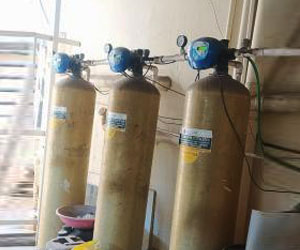
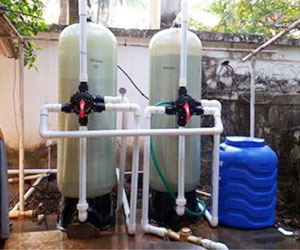
Our NATSOFT water conditioner plants are comprises of Mild Steel /SS / FRP Pressure Vessel, regeneration tank, ejector assembly, frontal piping wok with manual / Automatic multi port valve butterfly valve / conventional valves for easy operation and control. Available from 1,000 Liters/hr. to 10,00,000 Liters / day.




WEBSITE DESIGN AND MAINTAINED BY CLEMENCE WEB SOLUTIONS