

Hard water often proves unsuitable for many industrial and domestic purposes. When ‘hard’ water is mentioned, it indicates the presence of excess calcium (Ca) and magnesium (Mg) ions compared to normal water. Carbonate hardness is identified as temporary hardness, while non-carbonate hardness is labeled as permanent hardness. The hardness of water increases as more calcium and magnesium ions dissolve into it. Limestone sediments and carbon dioxide, present in all waters exposed to the atmosphere and especially in groundwater, contribute to these ions. The ion exchange process provides the simplest method for softening hard water.

The ion exchange process, used for softening, involves resin and is a common and easy method for removing hardness (calcium and magnesium) from water. In ion exchange, undesirable ions are replaced with more desirable ones. During the softening process, raw water with hardness passes through a bed of cation resin in sodium form. The resin captures calcium (Ca) and magnesium (Mg) ions and releases sodium ions in exchange. This process, known as the service cycle, softens the hard water.
Ca (HCO3)2 + Na2 R = RCa + NaHCO3
CaSO4 + Na2 R = RCa + Na2SO4MgCl2 + Na2
R = RMg + NaCl
The resin softens raw water until exhausted. Regeneration, using sodium chloride (NaCl) solution stored in the regeneration tank, restores the resin. The ejector tube injects the solution, replacing calcium (Ca) and magnesium (Mg) ions. Regeneration occurs daily, every few days, or weekly based on plant design and usage.
RCa + NaCl = RNa + CaCl2
RMg + NaCl = RNa + MgCl2
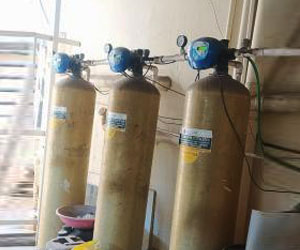
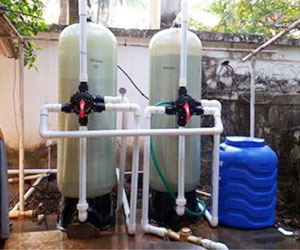
Our NATSOFT water conditioner plants include Mild Steel, SS, or FRP pressure vessels, a regeneration tank, an ejector assembly, and frontal piping work with manual or automatic multi-port valves, butterfly valves, or conventional valves for easy operation and control. These systems are available in capacities ranging from 1,000 liters per hour to 1,000,000 liters per day.




WEBSITE DESIGN AND MAINTAINED BY CLEMENCE WEB SOLUTIONS