

We hold expertise in successfully meeting the demands of a wide range of water treatment systems that include treatment plants as well as other associated accessories finding application in both commercials as well as domestic use. The in-depth process knowledge of our team allows us to deliver this optimum functionality as well as service life standards.
Iron is an objectionable constituent of portable water. Iron in water imparts a bitter characteristic, metallic.
Hard water is frequently unsuitable for many industrial and domestic purposes. When water is referred to as ‘Hard’ it simply means.
We produce a wide range of standardized and custom-built filtration systems to remove suspended solids from water.
Activated carbon has been historically used for the removal of odor, removal of color pigments from water. Further, our expertise.
The MGF works on the principle of retention and removal of physical impurity in a graded manner through Voids of the filtering media.
The pH range in water is 0 to 14, permissible limit is 6.5 – 8.5 for general use. pH 7.0 being neutral. pHs of less than 6.5




Iron in portable water imparts a bitter, metallic taste and causes oxidized precipitates, resulting in a yellowish-brown to reddish-brown coloration. This makes the water unpleasant and unsuitable for use, and iron stains everything it touches. Iron exists as ferrous iron (Fe++) or ferric iron (Fe+++), with ferric iron typically appearing as a precipitate. Iron forms complexes with hydroxides and other compounds in the presence of bicarbonate, sulfate, phosphate, cyanide, or halides. Organic substances can increase iron’s solubility by forming organic complexes. Water with high alkalinity generally contains less iron than water with low alkalinity.

Hard water is unsuitable for many industrial and domestic uses due to its excess calcium (Ca) and magnesium (Mg) ions. Carbonate hardness is temporary, while non-carbonate hardness is permanent. As calcium and magnesium dissolve, the water hardens. These ions usually come from limestone sediments and carbon dioxide in groundwater. The ion exchange process is the simplest way to soften hard water.

We produce a wide range of standardized and custom-built filtration systems designed to remove suspended solids from water. We use pressure sand filters in the treatment systems of RO plants (ROP) and in the post-treatment systems of wastewater treatment plants (STP & ETP).
Raw water passes through the pressure sand filter, where media on a gravel bed—graded quartz sand, fine sand, superfine white sand, and larger pebbles—captures dirt and particles. As the filter media loads with particles, pressure drop increases. We shut down the filter for cleaning when the pressure drop reaches a set level.
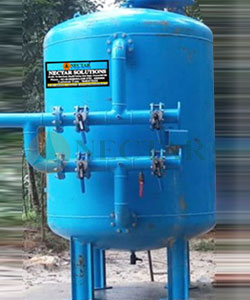
We use activated carbon to remove odors and color from water. We offer both domestic and industrial activated carbon filters, which are used in RO plants and wastewater treatment systems. Our filters eliminate bad taste, odors, and chlorine, using high-iodine value carbon granules to adsorb contaminants.
The water flows through the activated carbon filter, where the filter media consists of activated granular carbon. The activated carbon adsorbs free chlorine, organic compounds, color, and odor onto its surface. A multilayer gravel bed supports the activated carbon bed. We also backwash the activated carbon bed at regular intervals to dislodge any accumulated dirt particles.

The MGF retains and removes physical impurities in a graded manner through the voids of the filtering media.
The MGF retains and removes physical impurities in a graded manner through the voids of the filtering media.

Many industrial and domestic purposes find hard water unsuitable. When we refer to water as ‘hard,’ we mean it contains excess calcium (Ca) and magnesium (Mg) ions compared to normal water. We classify carbonate hardness as temporary hardness and non-carbonate hardness as permanent hardness. As more calcium and magnesium ions dissolve, the hardness of the water increases. These ions originate from limestone sediments and carbon dioxide present in all waters exposed to the atmosphere, particularly groundwater. We can soften hard water most easily using the ion exchange process.

WEBSITE DESIGN AND MAINTAINED BY CLEMENCE WEB SOLUTIONS