Everything You Need to Know Before Investing in a Commercial RO Plant
Water quality plays a crucial role in the success of commercial establishments. Whether you operate a hotel, hospital, restaurant, school, apartment, or manufacturing unit, access to clean and purified water is essential. However, many water sources contain dissolved salts, chemicals, bacteria, viruses, and other contaminants that affect water quality and operational efficiency.
Therefore, investing in a Commercial RO Plant is one of the most effective ways to ensure a continuous supply of safe and purified water. Moreover, choosing the right RO system can improve productivity, reduce maintenance costs, and enhance customer satisfaction.
This Commercial RO Plant Buying Guide will help you understand the key factors to consider before making a purchase.
What Is a Commercial RO Plant?
A Commercial Reverse Osmosis (RO) Plant is an advanced water purification system designed to remove dissolved salts, impurities, microorganisms, and harmful contaminants from water.
Unlike domestic RO systems, commercial RO plants handle larger volumes of water and are specifically designed for businesses and institutions that require continuous water purification.
Consequently, these systems provide high-quality water suitable for drinking, cooking, processing, and industrial applications.
Why Do Businesses Need a Commercial RO Plant?
Because water quality directly impacts operations, businesses must ensure a reliable source of purified water.
A Commercial RO Plant helps:
- Improve water quality
- Remove harmful contaminants
- Protect equipment from scaling
- Meet regulatory standards
- Reduce maintenance costs
- Enhance operational efficiency
As a result, businesses benefit from consistent water quality and improved performance.
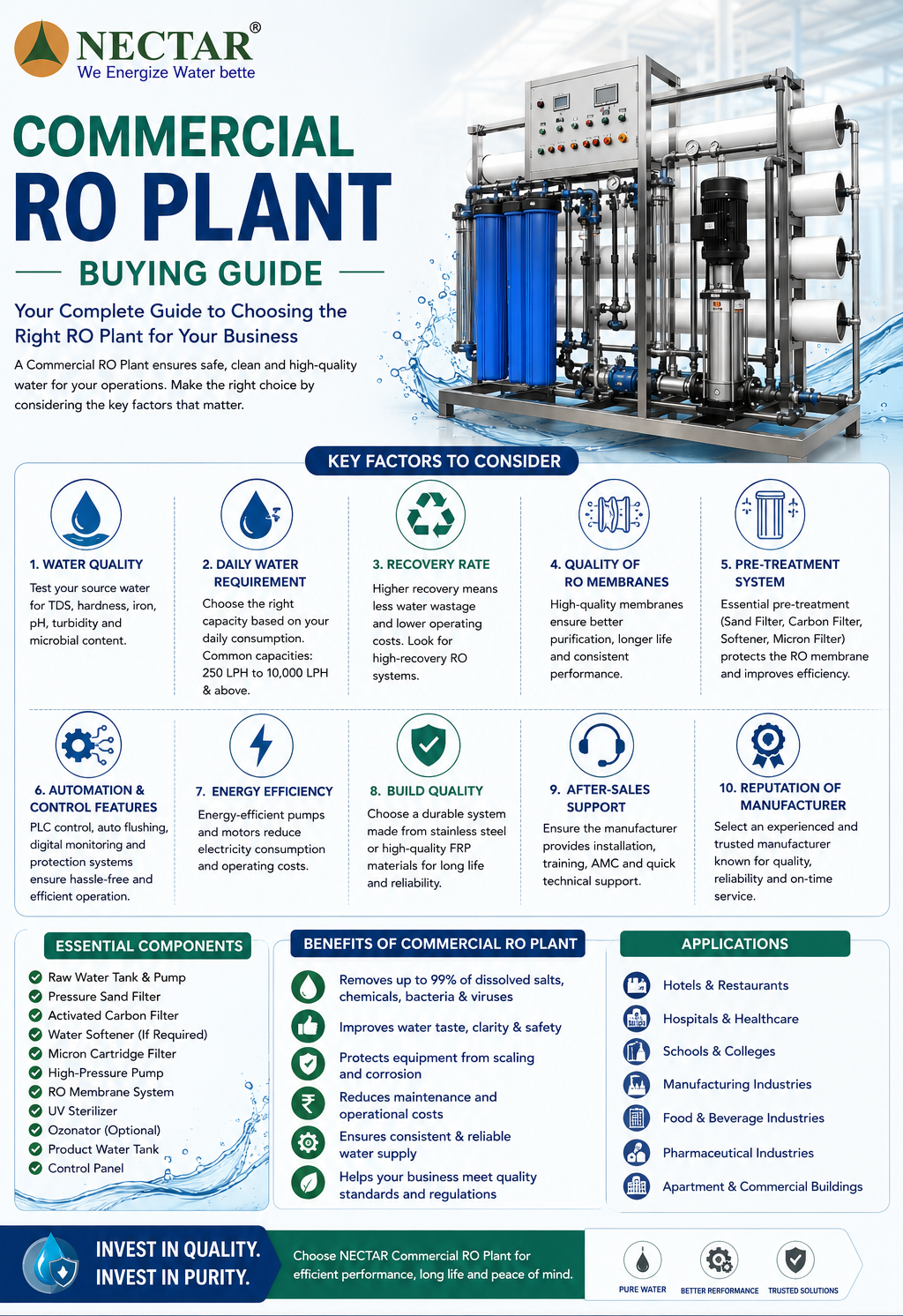
Key Factors to Consider Before Buying a Commercial RO Plant
1. Water Quality Analysis
Before selecting an RO plant, it is important to test the source water.
A water analysis should measure:
- TDS (Total Dissolved Solids)
- Hardness
- Iron content
- pH level
- Turbidity
- Microbial contamination
Therefore, accurate water testing helps determine the most suitable treatment system.
2. Daily Water Requirement
The capacity of an RO plant should match your daily water consumption.
Common commercial RO capacities include:
- 250 LPH
- 500 LPH
- 1000 LPH
- 2000 LPH
- 5000 LPH
- 10,000 LPH and above
Consequently, choosing the correct capacity prevents underperformance and unnecessary operating costs.
3. Recovery Rate
Recovery rate refers to the percentage of purified water produced from the incoming feed water.
Higher recovery systems offer:
- Reduced water wastage
- Lower operating costs
- Improved efficiency
Therefore, selecting a high-recovery RO plant can significantly improve long-term savings.
4. Quality of RO Membranes
The RO membrane is the heart of the purification system.
Because membrane quality directly affects performance, always choose systems equipped with premium-quality membranes.
Benefits include:
- Better purification
- Longer membrane life
- Lower maintenance costs
- Consistent water quality
As a result, businesses enjoy reliable and efficient operation.
5. Pre-Treatment System
An effective pre-treatment system protects the RO membrane from damage.
A complete pre-treatment setup typically includes:
- Pressure Sand Filter
- Activated Carbon Filter
- Water Softener (if required)
- Micron Cartridge Filter
Consequently, membrane life is extended and system performance improves.
6. Automation and Control Features
Modern commercial RO plants include advanced automation features.
These may include:
- PLC Control Systems
- Automatic flushing
- Digital monitoring
- Auto shut-off protection
- Flow and pressure monitoring
Therefore, automation reduces manual intervention and improves operational efficiency.
7. Energy Efficiency
Because commercial RO plants operate continuously, energy consumption becomes a significant factor.
Energy-efficient systems help:
- Reduce electricity bills
- Lower operating expenses
- Improve sustainability
As a result, businesses achieve better long-term profitability.
Essential Components of a Commercial RO Plant
A standard commercial RO system typically includes:
- Raw Water Storage Tank
- Raw Water Pump
- Pressure Sand Filter
- Activated Carbon Filter
- Water Softener
- Micron Cartridge Filter
- High-Pressure Pump
- RO Membrane System
- UV Sterilizer
- Ozonator
- Product Water Storage Tank
- Electrical Control Panel
Therefore, every component contributes to efficient water purification and system reliability.
Benefits of Installing a Commercial RO Plant
Superior Water Quality
RO technology removes up to 99% of dissolved impurities and contaminants.
Reduced Maintenance Costs
Furthermore, purified water minimizes scale formation and protects equipment.
Compliance with Water Standards
RO plants help businesses meet drinking water and industrial water quality regulations.
Improved Equipment Lifespan
Consequently, boilers, chillers, processing equipment, and plumbing systems operate more efficiently.
Consistent Water Supply
Therefore, businesses can maintain uninterrupted operations and productivity.
Industries That Use Commercial RO Plants
Because purified water is essential across many sectors, commercial RO plants are widely used in:
Hospitality Industry
- Hotels
- Resorts
- Restaurants
Healthcare Sector
- Hospitals
- Clinics
- Laboratories
Educational Institutions
- Schools
- Colleges
- Universities
Manufacturing Industries
- Food and Beverage
- Pharmaceuticals
- Textiles
- Electronics
- Chemical Processing
Residential and Commercial Buildings
- Apartments
- Office complexes
- Shopping malls
Consequently, commercial RO systems serve a wide range of water treatment applications.
Common Mistakes to Avoid When Buying a Commercial RO Plant
Many buyers focus only on price. However, several other factors are equally important.
Avoid these common mistakes:
- Ignoring water quality testing
- Selecting insufficient capacity
- Choosing low-quality membranes
- Overlooking after-sales support
- Ignoring energy efficiency
- Skipping pre-treatment systems
Therefore, careful planning helps ensure maximum return on investment.
How to Choose the Right RO Plant Manufacturer
A reliable manufacturer should offer:
- Industry experience
- Customized solutions
- Quality components
- Installation support
- Technical assistance
- AMC and maintenance services
Moreover, a trusted supplier ensures long-term system performance and customer satisfaction.
Conclusion
A Commercial RO Plant is a valuable investment for businesses that require safe, clean, and high-quality water. However, selecting the right system requires careful consideration of water quality, capacity, recovery rate, membrane quality, automation features, and after-sales support.
Therefore, conducting proper research before purchasing can help you choose the most efficient and cost-effective solution. As a result, your business can enjoy reliable water purification, lower operating costs, improved productivity, and long-term operational success.