Complete Guide to RO Water Treatment
Clean and reliable water is essential for homes, commercial facilities, and industries. However, water from borewells, groundwater, and other sources may contain high levels of dissolved salts, hardness minerals, metals, suspended impurities, and other contaminants. Therefore, an effective treatment process becomes necessary when source-water quality does not meet the requirements of its intended use.
RO water treatment, or Reverse Osmosis water treatment, is one of the most widely used technologies for reducing dissolved salts and many other dissolved contaminants. This Complete Guide to RO Water Treatment explains how RO works, its treatment stages, benefits, applications, maintenance requirements, and important factors to consider before installing an RO plant.
What Is RO Water Treatment?
Reverse Osmosis is a membrane-based water purification process. An RO system uses pressure to push pretreated water through a semi-permeable membrane.
The membrane allows water molecules to pass while rejecting a significant proportion of dissolved salts and other substances. Consequently, the RO process creates two water streams:
- Permeate: Treated water that passes through the membrane
- Concentrate or reject: Water containing a higher concentration of rejected dissolved substances
Therefore, RO provides an effective solution when lower-TDS water is required for drinking, commercial operations, or industrial processes.
Why Is RO Water Treatment Important?
Water quality varies considerably depending on the source and location. For example, borewell water may contain high TDS, hardness, iron, or salinity. Meanwhile, industrial applications may require water with controlled mineral content.
Therefore, RO water treatment can help reduce unwanted dissolved substances and provide more consistent treated-water quality.
Furthermore, industries can integrate RO with other treatment technologies to achieve specific water-quality requirements.
How Does Reverse Osmosis Work?
Natural osmosis moves water through a semi-permeable membrane from a solution with lower dissolved-solids concentration toward one with higher concentration.
Reverse Osmosis uses external pressure to drive the process in the opposite direction.
First, pretreatment removes contaminants that could damage or foul the membrane. Next, a high-pressure pump sends water through the RO membrane.
Consequently, purified permeate passes through the membrane while concentrated salts remain in the reject stream.
Finally, the treated water may undergo post-treatment or disinfection depending on its intended application.
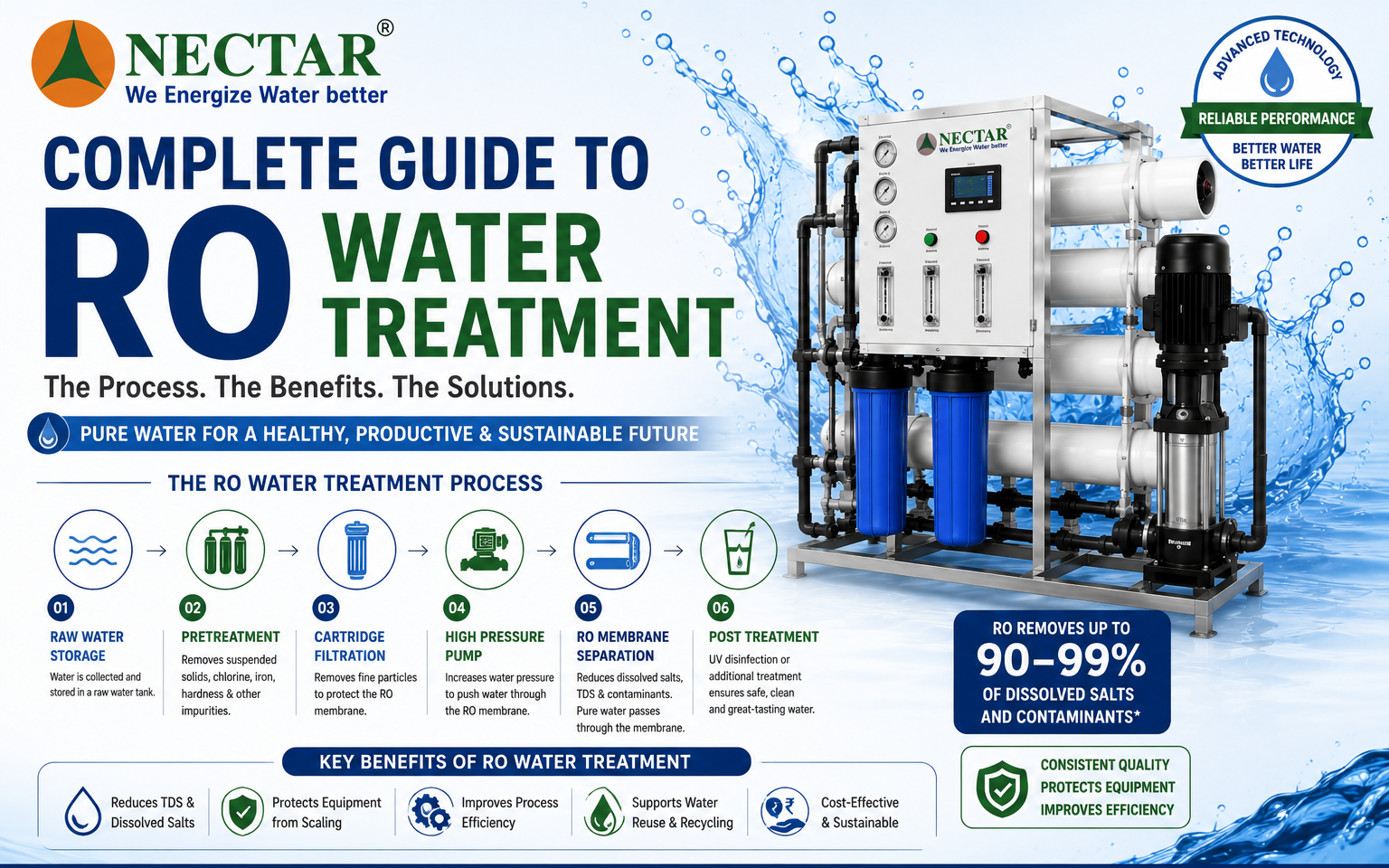
Main Stages of an RO Water Treatment System
A properly designed RO plant generally includes several treatment stages.
1. Raw Water Storage
Initially, source water enters a raw-water storage tank. This stage helps maintain a consistent water supply to the treatment plant.
Next, a feed pump transfers water into the pretreatment system.
2. Pretreatment
Pretreatment protects the RO membrane from suspended solids, iron, hardness, chlorine, organic matter, and other problematic substances.
Depending on the raw-water analysis, pretreatment may include:
- Pressure Sand Filter
- Multi Grade Filter
- Activated Carbon Filter
- Iron Removal Plant
- Water Softener
- Micron Cartridge Filter
- Chemical dosing
Therefore, proper pretreatment plays a major role in maintaining membrane performance.
3. Cartridge Filtration
A micron cartridge filter provides an additional barrier before the RO membrane.
It captures fine suspended particles that pass through earlier filtration stages. Consequently, it helps reduce particulate fouling of the membrane.
4. High-Pressure Pump
Next, the high-pressure pump supplies the pressure required for Reverse Osmosis.
Correct pressure is essential because insufficient pressure reduces permeate production. However, unnecessary pressure increases energy consumption.
Therefore, the operating pressure should match the membrane design and source-water conditions.
5. RO Membrane Separation
The RO membrane is the heart of the treatment system.
As pressurized water flows across the membrane surface, a portion passes through as permeate while rejected dissolved substances remain concentrated in the reject stream.
Depending on system design and feed-water characteristics, RO can significantly reduce TDS and many dissolved contaminants.
6. Post-Treatment
RO permeate may require additional treatment depending on its final application.
Post-treatment can include:
- UV disinfection
- pH adjustment
- Remineralization
- Additional polishing filtration
- Other application-specific processes
Therefore, post-treatment should be selected according to the required final water quality.
What Does an RO System Reduce?
A properly designed RO system can reduce many dissolved substances, including:
- Total Dissolved Solids (TDS)
- Sodium
- Chlorides
- Sulphates
- Calcium
- Magnesium
- Hardness-related minerals
- Many dissolved metals
- Various other dissolved contaminants
However, removal efficiency varies according to membrane type, water chemistry, temperature, pressure, and system condition.
Therefore, laboratory water testing should guide the treatment design.
Reverse Osmosis provides several important advantages.
Better Water Quality
RO significantly reduces dissolved salts and unwanted minerals. As a result, it can provide water suitable for applications that require lower TDS.
Consistent Treatment
A professionally designed system can maintain relatively consistent treated-water quality despite reasonable variations in source-water conditions.
Equipment Protection
Reducing dissolved minerals can help control scaling and deposits in certain downstream equipment.
Consequently, properly treated water may help protect boilers, process equipment, and other systems.
Flexible Applications
RO plants are available in capacities ranging from small drinking-water systems to large industrial installations.
Therefore, the technology can serve many different water-treatment requirements.
Supports Water Reuse
When integrated with suitable upstream treatment, RO can form part of industrial wastewater-recycling systems.
As a result, facilities may reuse treated water for appropriate applications and reduce demand for fresh water.
Domestic RO Water Treatment
Domestic RO purifiers are primarily used for drinking-water applications where source-water testing indicates that RO is appropriate.
A typical domestic system may combine:
Sediment Filtration → Activated Carbon → RO → Post-Treatment
However, an RO purifier should not automatically be selected for every home. If source water has suitable TDS and does not contain contaminants requiring RO, another purification technology may be more appropriate.
Therefore, testing the water first is the best approach.
Commercial RO Water Treatment
Commercial RO plants are commonly installed where larger volumes of treated water are required.
Applications include:
- Hotels and restaurants
- Schools and colleges
- Hospitals
- Offices
- Commercial complexes
- Hostels
- Food-service facilities
Moreover, commercial systems can be designed with automatic controls to simplify daily operation.
Industrial RO Water Treatment
Industrial RO plants provide controlled water quality for production and utility requirements.
Common industries include:
- Food and Beverage
- Pharmaceutical
- Textile
- Automobile
- Chemical
- Electronics
- Manufacturing
- Power generation
- Process industries
Depending on the application, industrial RO systems can operate as standalone treatment plants or as part of a larger water-treatment process.
Importance of Pretreatment Before RO
Many RO problems originate from inadequate pretreatment.
For example, suspended particles can foul membranes, hardness minerals can contribute to scaling, and iron can create deposits. Furthermore, chlorine can damage many commonly used polyamide RO membranes.
Therefore, pretreatment must address the actual contaminants in the source water.
For iron-rich borewell water, an Iron Removal Plant may be required. Similarly, high-hardness water may require suitable scale-control measures.
Consequently, correct pretreatment improves reliability and can reduce unnecessary membrane replacement.
RO Recovery and Reject Water
An RO system does not convert all feed water into permeate. Some water leaves the system as concentrate or reject.
Recovery can be expressed as:
Recovery (%) = Permeate Flow ÷ Feed Flow × 100
Higher recovery can reduce reject-water volume. However, increasing recovery excessively can raise the concentration of salts near the membrane and increase scaling risk.
Therefore, recovery should be optimized according to feed-water chemistry, membrane configuration, and manufacturer recommendations.
Like any treatment system, an RO plant may experience operational issues.
Common problems include:
- Low permeate production
- High treated-water TDS
- Membrane scaling
- Membrane fouling
- High pressure
- Low pressure
- Frequent cartridge-filter blockage
- Excessive reject flow
- Pump problems
- Poor pretreatment performance
Fortunately, regular monitoring can identify many of these issues before they cause major system failures.
Preventive maintenance is essential for reliable RO operation.
Operators should regularly monitor:
- Feed-water TDS
- Permeate TDS
- Feed pressure
- Membrane operating pressure
- Permeate flow
- Reject flow
- Recovery rate
- Filter pressure drop
- Chemical dosing
Furthermore, cartridge filters should be changed when necessary, while membranes should be cleaned according to performance data and manufacturer recommendations.
Therefore, maintaining an operating logbook is highly beneficial.
There is no universal replacement interval for every RO membrane.
Membrane life depends on:
- Source-water quality
- Pretreatment effectiveness
- Operating pressure
- Recovery rate
- Fouling and scaling
- Chemical exposure
- Cleaning procedures
- Daily operating hours
Therefore, membranes should be evaluated based on performance rather than replaced according to an arbitrary schedule.
If salt rejection declines significantly or cleaning no longer restores performance, replacement may become necessary.
Before purchasing an RO system, begin with a complete water analysis.
Consider:
- Source-water TDS
- Hardness
- Iron and manganese
- pH
- Turbidity
- Chloride and sulphate
- Daily water demand
- Peak flow requirement
- Required treated-water quality
- Intended application
Furthermore, evaluate operating costs, reject-water management, available installation space, automation requirements, and after-sales support.
Therefore, choosing an RO plant based solely on price or LPH capacity is not recommended.
Borewell water frequently requires customized treatment because its composition varies significantly.
For example, if the water contains high iron and high TDS, a possible treatment sequence may be:
Raw Water → Iron Removal → Additional Pretreatment → Cartridge Filtration → RO → Post-Treatment
However, if hardness or other contaminants are present, additional stages may be required.
Therefore, professional water testing is particularly important for borewell applications.
You can improve RO performance by:
- Testing feed water regularly
- Maintaining effective pretreatment
- Preventing scaling and fouling
- Maintaining appropriate pressure
- Optimizing recovery
- Monitoring permeate and reject flow
- Monitoring feed and permeate TDS
- Cleaning membranes when required
- Maintaining pumps and motors
- Scheduling preventive servicing
As a result, the RO plant can provide more reliable performance and consistent treated-water quality.
This Complete Guide to RO Water Treatment shows that Reverse Osmosis is much more than a membrane alone. Effective RO treatment requires proper water analysis, pretreatment, membrane selection, operating pressure, recovery control, post-treatment, and preventive maintenance.
RO technology can significantly reduce TDS, dissolved salts, hardness-related minerals, and many other dissolved contaminants. Therefore, it is widely used in residential, commercial, and industrial water-treatment applications.
However, the most effective RO system is one designed around the actual source-water quality and required treated-water specifications. By testing your water first and selecting the correct treatment stages, you can achieve reliable water quality, better membrane performance, and efficient long-term operation.