How to Increase RO Plant Efficiency
Reverse Osmosis (RO) plants play an important role in producing treated water for industries, commercial facilities, institutions, and other applications. However, poor pretreatment, membrane scaling, incorrect pressure, high reject flow, and inadequate maintenance can reduce system performance and increase operating costs. Therefore, understanding how to increase RO plant efficiency is essential for achieving consistent water quality and reliable plant operation.
An efficient RO plant should balance permeate production, salt rejection, energy consumption, recovery, and membrane life. Moreover, regular monitoring helps operators identify performance changes before they become expensive problems.
What Is RO Plant Efficiency?
RO plant efficiency refers to how effectively the system converts feed water into treated permeate while maintaining the required water quality and operating within appropriate pressure, recovery, and energy limits.
Several factors influence efficiency, including:
- Feed-water quality
- RO membrane condition
- Pretreatment performance
- Operating pressure
- Water temperature
- Recovery rate
- Membrane scaling and fouling
- Chemical dosing
- System maintenance
Therefore, improving RO efficiency requires attention to the complete treatment process rather than focusing only on the membrane.
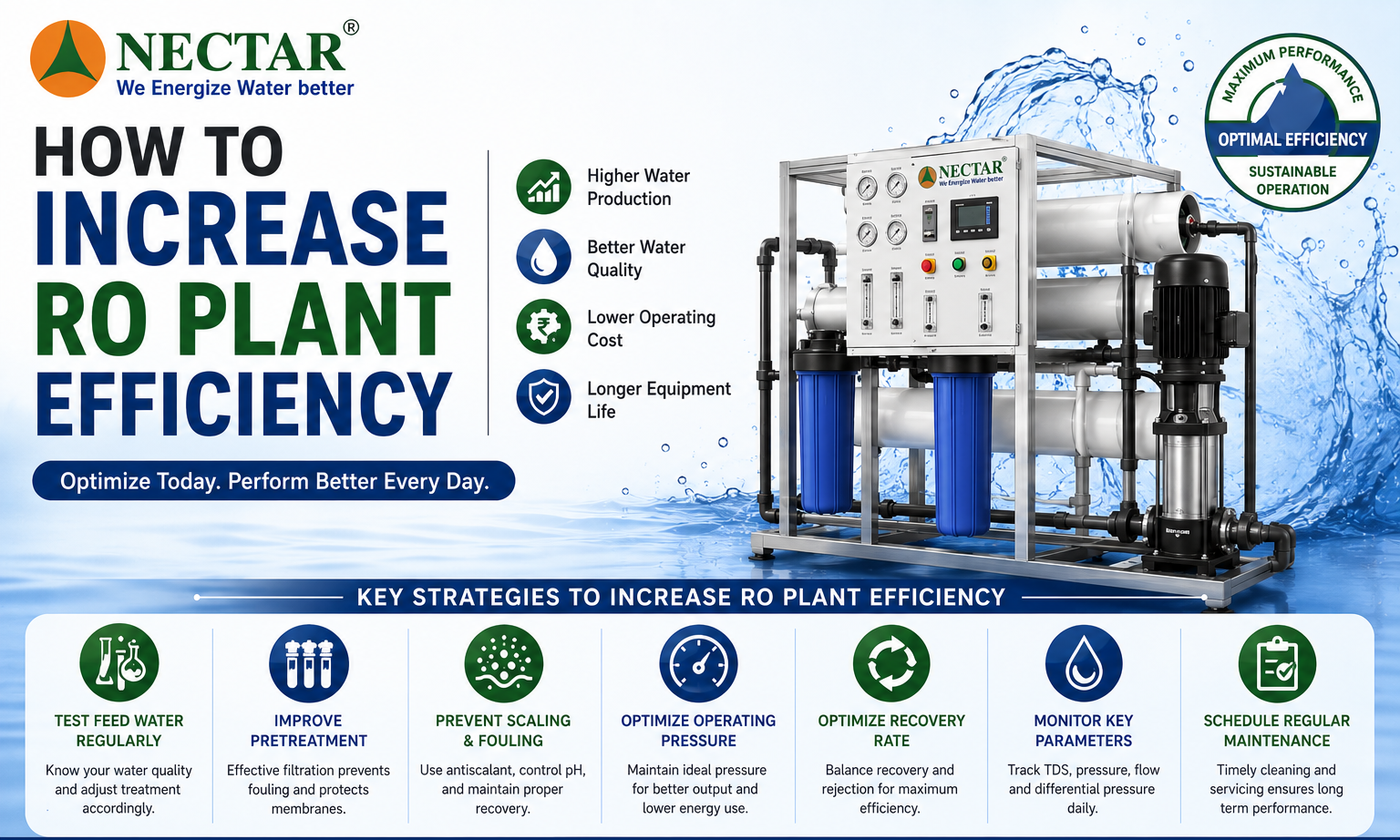
1. Test Feed Water Regularly
Water testing is the foundation of efficient RO operation. Feed-water quality can change over time, especially when the plant uses borewell or groundwater.
Therefore, periodically monitor important parameters such as:
- TDS
- pH
- Total hardness
- Iron
- Manganese
- Turbidity
- Chloride
- Silica where relevant
- Microbiological parameters where applicable
Once operators understand the feed-water characteristics, they can adjust pretreatment and operating conditions more effectively.
2. Improve RO Pretreatment
Effective pretreatment is one of the best ways to increase RO plant efficiency.
Suspended solids, iron, hardness minerals, chlorine, organic matter, and other contaminants can damage or foul RO membranes. Consequently, inadequate pretreatment leads to lower permeate production and frequent membrane cleaning.
Depending on the feed-water analysis, pretreatment may include:
- Multi Grade Filter
- Pressure Sand Filter
- Activated Carbon Filter
- Iron Removal Plant
- Water Softener
- Cartridge Filter
- Antiscalant dosing
- Other application-specific treatment
Therefore, pretreatment should be designed according to the actual source-water quality.
3. Prevent RO Membrane Scaling
Scaling occurs when concentrated dissolved salts precipitate on membrane surfaces.
As scaling increases, the RO plant may require higher pressure to maintain production. Moreover, permeate flow can decline while energy consumption increases.
To reduce scaling:
- Monitor feed-water hardness.
- Maintain the recommended recovery rate.
- Use appropriate antiscalant where required.
- Control pH when the design calls for it.
- Monitor membrane performance.
- Clean membranes when performance data indicates scaling.
Consequently, proper scale control helps maintain stable membrane performance.
4. Reduce Membrane Fouling
Membrane fouling can result from suspended particles, organic material, microorganisms, iron, and other contaminants.
Therefore, operators should monitor pretreatment filters and replace or backwash them at appropriate intervals.
Furthermore, avoid allowing heavily contaminated water to reach the RO membrane. Effective filtration before RO reduces membrane fouling and can extend membrane service life.
RO membranes require sufficient pressure to overcome osmotic pressure and produce permeate. However, operating at unnecessarily high pressure can increase energy consumption and place additional stress on system components.
Therefore, monitor:
- Feed pressure
- Pre-filter pressure drop
- Membrane inlet pressure
- Concentrate pressure
- Permeate flow
If pressure gradually rises while normalized production falls, membrane fouling or scaling may be developing.
6. Optimize the RO Recovery Rate
Recovery refers to the percentage of feed water converted into permeate.
A simple representation is:
Recovery (%) = Permeate Flow ÷ Feed Flow × 100
Increasing recovery can reduce the amount of reject water. However, excessively high recovery increases the concentration of salts near the membrane and may raise scaling risk.
Therefore, the best recovery rate depends on feed-water chemistry, membrane design, pretreatment, staging, and manufacturer recommendations.
Do not simply restrict the reject line to increase recovery. Instead, optimize the complete system professionally.
7. Monitor Permeate and Reject Flow
Flow measurements provide valuable information about RO plant performance.
Operators should regularly record:
- Feed-water flow
- Permeate flow
- Concentrate/reject flow
- Recovery percentage
If permeate flow suddenly decreases, investigate the cause immediately. For example, blocked filters, low pressure, scaling, fouling, or membrane deterioration may be responsible.
As a result, early troubleshooting can prevent larger performance losses.
8. Monitor Feed and Permeate TDS
TDS monitoring helps determine whether the RO membrane continues to reject dissolved salts effectively.
Instead of checking only permeate TDS, compare it with feed-water TDS.
Salt rejection can be estimated using:
Salt Rejection (%) = [1 − (Permeate TDS ÷ Feed TDS)] × 100
A meaningful decline in rejection may indicate membrane damage, seal problems, fouling, or another operating issue.
Therefore, maintaining historical records makes it easier to identify gradual deterioration.
9. Clean RO Membranes at the Right Time
RO membranes require cleaning when fouling or scaling causes significant performance deterioration.
However, cleaning membranes too frequently increases chemical use and downtime. On the other hand, waiting until severe fouling develops can make cleaning less effective.
Therefore, membrane cleaning should be based on operating data and membrane-manufacturer guidance.
Professional Clean-in-Place (CIP) procedures use appropriate cleaning solutions to address specific foulants while protecting membrane materials.
10. Replace Cartridge Filters on Time
Cartridge filters provide the final particulate barrier before the RO membrane.
If cartridges become heavily clogged, pressure drop increases and membrane feed pressure may decrease. Consequently, RO output can fall.
Therefore, monitor the pressure differential across cartridge filters and replace them according to operating conditions rather than relying only on a fixed calendar schedule.
Moreover, frequent cartridge blockage may indicate that upstream pretreatment needs improvement.
High-pressure pumps account for a significant portion of an RO plant’s energy consumption.
Therefore, pump efficiency directly affects overall system efficiency.
Regularly inspect:
- Pump pressure
- Flow rate
- Unusual vibration
- Unusual noise
- Seals and bearings
- Motor condition
- Electrical performance
Furthermore, ensure that pumps operate close to their intended operating range.
Proper pump maintenance can reduce energy waste and unexpected downtime.
Iron-rich borewell water can create serious membrane fouling problems.
When dissolved iron oxidizes, deposits can accumulate on cartridge filters and membrane surfaces. Consequently, pressure requirements may rise while permeate production declines.
Therefore, if testing confirms problematic iron concentrations, install an appropriate Iron Removal Plant before the RO system.
Removing iron during pretreatment can improve membrane protection and overall RO reliability.
Many commonly used polyamide RO membranes can be damaged by continuous exposure to free chlorine.
Therefore, systems treating chlorinated feed water often require appropriate dechlorination before the membrane.
Activated carbon or controlled chemical dechlorination may be used depending on system design.
However, operators must also manage microbiological risks carefully because removing disinfectant residual can encourage biological growth under some conditions.
Energy optimization can significantly improve the economics of commercial and industrial RO plants.
Possible strategies include:
- Maintaining clean membranes
- Keeping filters clean
- Optimizing operating pressure
- Maintaining efficient pumps
- Correctly sizing equipment
- Using appropriate controls
- Considering energy-recovery technologies for suitable high-pressure applications
Therefore, energy efficiency should be considered during both plant design and ongoing operation.
A detailed operating log is one of the simplest tools for improving RO performance.
Record important parameters such as:
- Feed TDS
- Permeate TDS
- Feed pressure
- Membrane pressure
- Permeate flow
- Reject flow
- Recovery percentage
- pH
- Filter pressure drop
- Chemical dosing
- Cleaning dates
Consequently, operators can identify trends and detect problems before they cause system failure.
Waiting until an RO plant stops working can result in expensive downtime.
Instead, create a preventive maintenance schedule covering filters, membranes, pumps, valves, sensors, dosing systems, tanks, and electrical controls.
Regular maintenance helps:
- Reduce unexpected failures
- Maintain water quality
- Improve equipment reliability
- Reduce unnecessary energy consumption
- Extend component life
- Control maintenance costs
Therefore, preventive servicing is an important part of efficient RO plant management.
An efficiently operated RO plant can provide several advantages:
- Higher and more consistent permeate production
- Stable treated-water quality
- Reduced membrane fouling
- Lower avoidable energy consumption
- Better water recovery
- Reduced unplanned downtime
- Longer equipment life
- More predictable maintenance costs
Moreover, optimizing the system can reduce unnecessary water and energy losses.
Maintenance cannot solve every efficiency problem. Older plants may have undersized pretreatment, inefficient pumps, outdated controls, or a design that no longer matches current feed-water conditions.
Consider a professional system evaluation if you experience:
- Repeated membrane failure
- Continuously increasing energy use
- Excessive reject water
- Frequent cartridge blockage
- Persistent scaling
- Unstable permeate quality
- Reduced production capacity
Consequently, targeted upgrades may provide better results than repeatedly replacing individual components.
Learning how to increase RO plant efficiency starts with understanding the complete water treatment process. Proper feed-water testing, effective pretreatment, scale and fouling control, correct operating pressure, optimized recovery, membrane maintenance, and accurate monitoring all contribute to better performance.
Furthermore, operators should regularly track TDS, pressure, permeate flow, reject flow, and recovery. These records provide early warning signs when plant performance begins to decline.
Ultimately, an efficient RO plant is not simply one that produces more water. It should consistently achieve the required treated-water quality while using water, energy, membranes, and other resources effectively. With professional system design and preventive maintenance, you can improve RO plant performance and achieve reliable long-term operation.