Common RO Plant Problems and Solutions
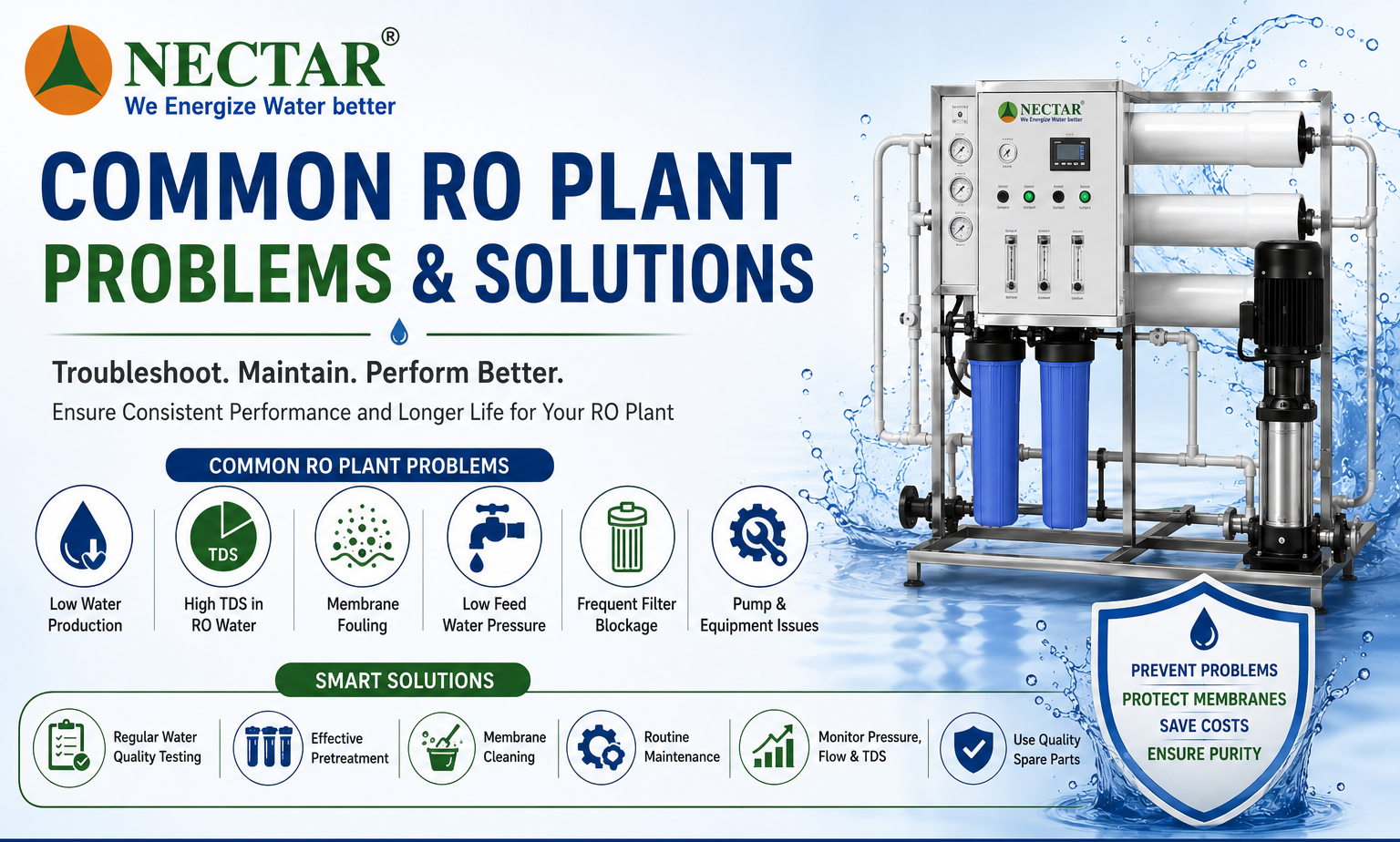
Reverse Osmosis (RO) plants provide reliable water purification for homes, commercial establishments, and industries. However, like any water treatment system, an RO plant may develop performance issues over time. Low water production, poor water quality, membrane fouling, high reject water, pressure problems, and unusual taste are some common concerns.
Understanding Common RO Plant Problems and Solutions helps plant owners identify issues early, reduce downtime, protect RO membranes, and maintain consistent treated-water quality. Moreover, preventive maintenance can significantly reduce unnecessary repair costs and improve overall system performance.
How Does an RO Plant Work?
An RO plant uses a semi-permeable membrane to separate a large proportion of dissolved salts and other contaminants from feed water.
First, pretreatment filters remove suspended particles and other substances that could affect the membrane. Next, a high-pressure pump pushes water through the RO membrane. Consequently, the system produces purified permeate water while carrying concentrated dissolved substances away through the reject stream.
Therefore, proper pretreatment, operating pressure, membrane condition, and routine maintenance are essential for reliable RO performance.
1. Low RO Water Production
Low permeate flow is one of the most common RO plant problems. If your system produces less treated water than its designed capacity, several factors may be responsible.
Possible Causes
- Low feed-water pressure
- Clogged sediment filters
- Membrane fouling or scaling
- Low feed-water temperature
- Pump performance problems
- Incorrect valve settings
Solution
First, check the feed pressure and prefilters. Next, inspect the high-pressure pump and operating parameters. If the membrane has become fouled or scaled, professional membrane cleaning may restore performance.
However, if membrane performance has deteriorated permanently, replacement may be necessary.
2. High TDS in RO Water
An RO plant should significantly reduce feed-water TDS when operating correctly. Therefore, an unexpected rise in product-water TDS may indicate a problem.
Possible Causes
- Damaged RO membrane
- Improperly seated membrane
- Worn seals or O-rings
- Incorrect operating pressure
- Membrane deterioration
- Internal leakage or mixing
Solution
Measure both feed-water and permeate TDS and calculate the system’s salt rejection. Furthermore, inspect membrane housings, seals, pressure, and flow conditions.
If the membrane no longer provides acceptable rejection despite correct operation and cleaning, replace it with a suitable membrane.
3. RO Membrane Fouling
Membrane fouling occurs when suspended solids, microorganisms, organic matter, or other contaminants accumulate on the membrane surface.
Consequently, the RO plant may experience reduced water output, increased pressure requirements, and declining performance.
Solution
Effective pretreatment is the best defence against fouling. Depending on the source water, pretreatment may include:
- Multi Grade Filtration
- Activated Carbon Filtration
- Iron Removal
- Cartridge Filtration
- Softening or antiscalant dosing
- Other application-specific treatment
Moreover, regular monitoring can help identify fouling before it becomes severe.
4. Membrane Scaling
Scaling occurs when dissolved minerals become concentrated and precipitate on the membrane surface. Calcium carbonate and other sparingly soluble salts can contribute to this problem depending on feed-water chemistry.
As a result, water production can decrease while operating pressure may increase.
Solution
Test the feed water before designing and operating an RO system. Depending on the analysis, appropriate solutions can include softening, pH adjustment, antiscalant dosing, recovery optimization, or membrane cleaning.
Therefore, controlling scaling requires a treatment strategy based on actual water chemistry.
Every conventional RO process produces a concentrate or reject stream. However, an unexpected increase in reject flow or decrease in recovery may indicate an operational issue.
Possible causes include incorrect flow-control settings, low feed pressure, membrane problems, or changes in source-water quality.
Solution
Check:
- Feed-water pressure
- Permeate flow
- Reject flow
- Recovery percentage
- Flow-control settings
- Membrane condition
However, avoid simply restricting the reject line to increase recovery. Excessively high recovery can increase scaling and damage membranes. Instead, operate the system according to its design and feed-water chemistry.
6. Low Feed-Water Pressure
RO membranes require adequate pressure for effective separation. Therefore, insufficient feed or operating pressure can significantly reduce treated-water production.
Possible Causes
- Low source-water supply
- Blocked prefilters
- Pump malfunction
- Pipeline restrictions
- Incorrect valve position
Solution
Inspect the water supply, pressure gauges, filters, valves, and pump. Moreover, replace clogged cartridges and repair defective pumps when necessary.
Maintaining stable pressure helps the membrane operate efficiently.
7. Frequent Cartridge Filter Blockage
Cartridge filters protect RO membranes from suspended contaminants. However, if they clog unusually quickly, the raw water may contain excessive turbidity, iron, sediment, or other particulate matter.
Solution
Instead of repeatedly replacing cartridges, investigate the underlying water-quality problem.
For example, the system may require improved pretreatment such as a Multi Grade Filter or Iron Removal Plant.
Consequently, proper pretreatment can reduce cartridge consumption and protect downstream RO membranes.
8. Iron Fouling in RO Plants
Borewell water may contain dissolved iron. When iron oxidizes, deposits can form on filters and membrane surfaces.
Consequently, untreated iron-rich water can reduce RO performance and increase maintenance requirements.
Solution
Test borewell water for iron before it reaches the RO system. If iron levels are problematic, install an appropriate Iron Removal Plant or pretreatment process.
Therefore, removing iron before RO can help protect membranes and improve system reliability.
9. Bad Taste or Odour in Treated Water
If RO-treated water develops an unusual taste or smell, several factors may be responsible.
These include:
- Exhausted activated carbon
- Stagnant water
- Poor system sanitation
- Contaminated storage tanks
- Microbial growth after treatment
Solution
Clean and sanitize the system and storage tank according to appropriate procedures. Furthermore, replace exhausted filters and inspect post-treatment components.
Where microbiological control is required, properly designed UV or another suitable disinfection stage may be considered.
10. RO Pump Making Unusual Noise
High-pressure pumps are critical components of commercial and industrial RO plants.
Unusual noise can result from:
- Insufficient feed water
- Air entering the pump
- Cavitation
- Worn components
- Incorrect operating conditions
Solution
Avoid continuously operating a noisy pump without inspection. First, check the feed-water level, suction line, valves, and pressure conditions. Then, arrange professional servicing if the noise continues.
Early intervention can prevent more expensive pump damage.
Frequent cycling can affect pumps and other electrical components.
Possible causes include:
- Faulty level sensors
- Pressure switch problems
- Electrical control issues
- Incorrect tank-level settings
- Unstable feed-water supply
Therefore, inspect sensors, switches, electrical panels, and storage-tank controls. Correct automation settings can improve both reliability and equipment life.
RO membranes do not have one fixed lifespan for every plant. Their service life depends on source-water quality, pretreatment, operating conditions, cleaning practices, and maintenance.
If membranes fail unusually quickly, simply replacing them may not solve the underlying problem.
Instead, investigate:
- Feed-water quality
- Iron concentration
- Hardness and scaling potential
- Chlorine exposure for chlorine-sensitive membranes
- Operating pressure
- Recovery rate
- Pretreatment performance
- Cleaning practices
Therefore, fixing the root cause can significantly improve membrane performance.
| RO Plant Problem | Common Cause | Recommended Action |
|---|---|---|
| Low water production | Fouling, low pressure | Check filters, pump and membrane |
| High permeate TDS | Membrane/seal problem | Check rejection and membrane condition |
| Frequent scaling | Mineral precipitation | Improve pretreatment and scaling control |
| Membrane fouling | Poor pretreatment | Improve filtration and clean membrane |
| Cartridge clogging | High suspended solids | Upgrade pretreatment |
| Iron deposits | Iron-rich feed water | Add suitable iron removal |
| Bad taste or smell | Sanitation/filter issue | Sanitize and inspect filters |
| Pump noise | Feed/pump issue | Inspect suction, pressure and pump |
| Frequent cycling | Sensor/control issue | Check automation controls |
Preventive maintenance is more effective than waiting for complete system failure. Therefore, plant operators should maintain a routine inspection schedule.
Important practices include:
- Test source water periodically
- Record feed and permeate TDS
- Monitor inlet and operating pressures
- Record permeate and reject flow rates
- Replace prefilters when required
- Monitor pressure drop across filters
- Maintain chemical dosing systems
- Clean membranes when performance data indicates the need
- Sanitize storage and distribution systems appropriately
- Schedule professional preventive maintenance
Moreover, maintaining an operating log makes it easier to identify gradual changes before they become major failures.
Many common RO plant problems begin before water reaches the membrane.
For example, iron can cause fouling, hardness minerals can contribute to scaling, and suspended solids can block filters. Therefore, a properly designed pretreatment system is essential.
Depending on the water analysis, pretreatment may include iron removal, multi-grade filtration, activated carbon filtration, softening, cartridge filtration, chemical dosing, or other technologies.
As a result, good pretreatment can reduce membrane problems and improve overall plant reliability.
Basic inspections and routine filter changes may be manageable for trained operators. However, persistent high TDS, rapid membrane fouling, major pressure changes, electrical faults, pump problems, or repeated membrane failure require professional diagnosis.
A qualified technician can evaluate the complete system instead of replacing components unnecessarily.
Therefore, professional troubleshooting can identify the root cause and prevent repeated failures.
Understanding Common RO Plant Problems and Solutions is essential for maintaining reliable water treatment performance. Problems such as low water production, high TDS, membrane fouling, scaling, excessive reject water, iron contamination, clogged filters, and pump issues often indicate that the system requires maintenance or improved pretreatment.
Most importantly, regularly monitor pressure, TDS, flow rates, recovery, and source-water quality. Furthermore, maintain filters, pumps, membranes, dosing systems, and storage tanks according to the plant’s operating requirements.
With proper pretreatment and preventive maintenance, an RO plant can deliver consistent water quality, reduce unexpected downtime, and provide dependable long-term operation.