Iron Removal Plant vs RO Plant: Which Water Treatment System Do You Need?
Clean water is essential for drinking, cooking, bathing, and protecting household appliances. However, different water problems require different treatment technologies. Two commonly used systems are Iron Removal Plants (IRP) and Reverse Osmosis (RO) Plants. Although both improve water quality, they perform very different functions.
Therefore, understanding Iron Removal Plant vs RO Plant is important before choosing a water treatment system. An Iron Removal Plant primarily targets iron and related impurities, while an RO Plant reduces a much broader range of dissolved substances. In many cases, proper testing may show that you need one system or a combination of both.
What Is an Iron Removal Plant?
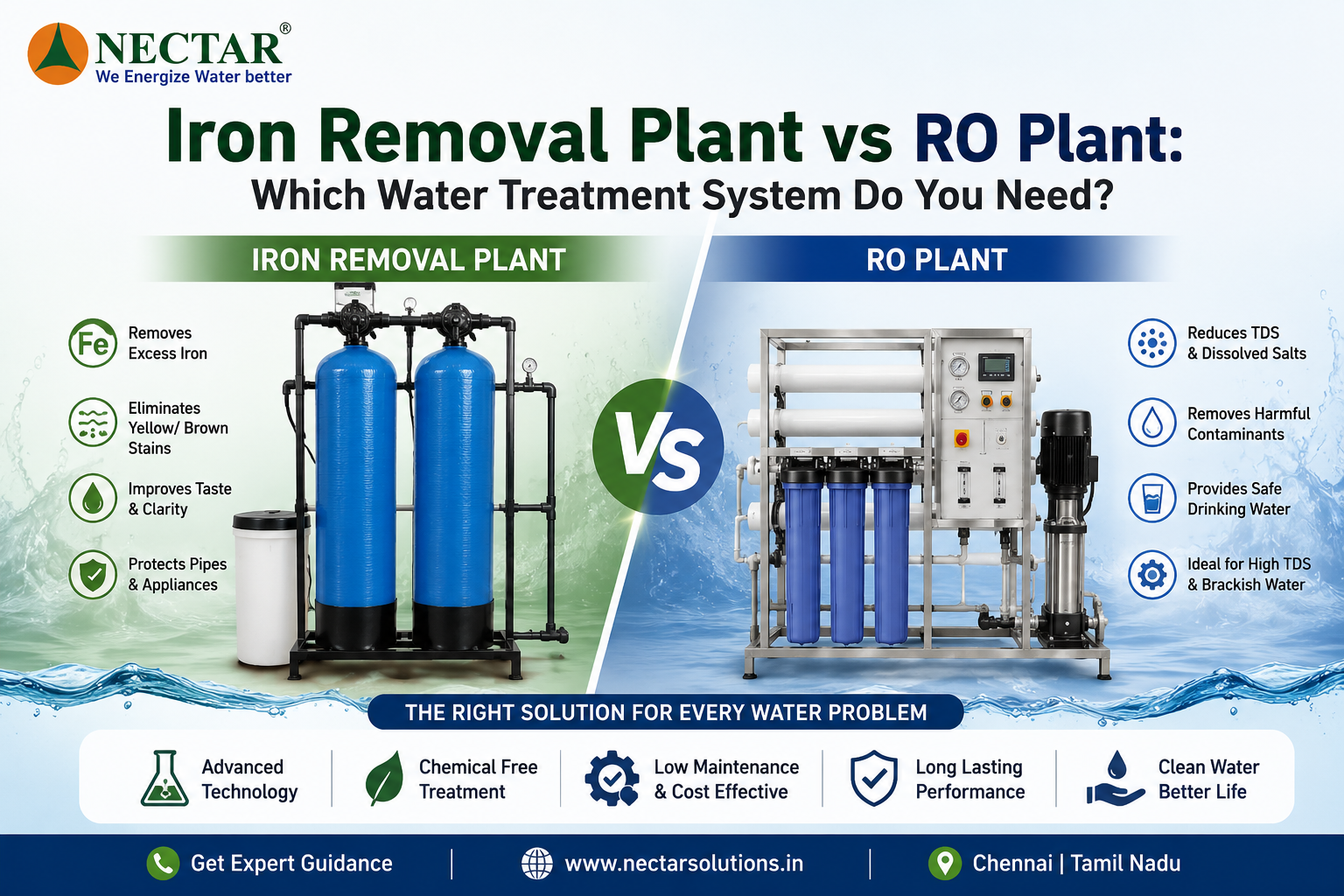
An Iron Removal Plant is designed primarily to reduce iron from borewell, groundwater, and other iron-rich water sources.
Groundwater may contain dissolved ferrous iron that initially appears clear. However, when exposed to oxygen, it can oxidize and form reddish-brown particles. Consequently, users may notice yellow or brown water, metallic taste, and rust-coloured stains.
An appropriately designed iron removal system generally uses oxidation followed by filtration. As a result, the system converts dissolved iron into filterable particles and removes them before the water reaches the point of use.
Common Problems an Iron Removal Plant Addresses
An Iron Removal Plant can help control:
- Dissolved and oxidized iron
- Yellow or brown discoloration caused by iron
- Rust-coloured deposits
- Metallic taste associated with iron
- Suspended iron particles
- Some iron-related odour problems, depending on the cause
Therefore, an IRP is particularly useful where iron is the main water-quality problem.
What Is an RO Plant?
A Reverse Osmosis Plant uses a semi-permeable membrane to reduce many dissolved substances from water.
During the RO process, pressure pushes feed water across the membrane. The membrane allows much of the water to pass while rejecting a significant proportion of dissolved salts and other contaminants.
Consequently, RO technology is widely used when the source water has high TDS, salinity, or other dissolved contaminants that require reduction.
What Can an RO Plant Reduce?
Depending on membrane type, operating conditions, and pretreatment, an RO system can reduce:
- Total Dissolved Solids (TDS)
- Dissolved salts
- Sodium
- Chloride
- Sulphates
- Hardness minerals
- Many dissolved metals
- Various other dissolved contaminants
Therefore, RO plants are commonly used for drinking water, process water, commercial facilities, and industrial applications.
Iron Removal Plant vs RO Plant: Key Differences
Although both systems treat water, they should not automatically be treated as alternatives.
| Feature | Iron Removal Plant | RO Plant |
|---|---|---|
| Primary purpose | Iron removal | Reduction of dissolved salts and contaminants |
| Best suited for | Iron-rich borewell water | High-TDS or saline water |
| Main technology | Oxidation + filtration | Membrane separation |
| Helps with yellow/brown iron staining | Yes | Pretreatment is generally preferable |
| TDS reduction | No significant reduction | Yes |
| Water recovery | Generally high | Produces permeate and reject streams |
| Pretreatment | Depends on water quality | Often essential |
| Typical use | Whole-building/pretreatment | Drinking, process and purified water |
Therefore, your water analysis—not simply the equipment name—should determine which system you choose.
You should consider an Iron Removal Plant when testing confirms elevated iron and you notice problems such as:
- Yellow, orange, or brown water
- Reddish stains on bathroom fittings
- Metallic-tasting water
- Iron deposits in storage tanks
- Frequent pipe deposits
- Stains on washed clothes
Moreover, removing iron before downstream equipment can help protect filters, membranes, pipes, and other components from fouling.
Therefore, an Iron Removal Plant is often an important pretreatment stage for iron-rich borewell water.
When Should You Choose an RO Plant?
An RO Plant may be suitable when laboratory testing identifies high levels of dissolved salts or other substances that RO membranes can effectively reject.
Common indications include:
- High TDS
- Salty or brackish water
- Excess hardness requiring broader treatment
- Process-water quality requirements
- Drinking-water purification requirements
However, RO should not automatically be installed for every water problem. Proper pretreatment, system sizing, membrane selection, recovery rate, and post-treatment all influence performance.
Can an RO Plant Remove Iron?
RO membranes can reject dissolved iron, but feeding iron-rich water directly into an RO system is generally poor system design.
Iron can oxidize and deposit on membrane surfaces. Consequently, membrane fouling may increase operating pressure, reduce water production, and shorten membrane life.
Therefore, when source water contains problematic iron levels, an Iron Removal Plant may be installed before the RO Plant.
A typical treatment sequence could be:
Raw Borewell Water → Iron Removal → Additional Pretreatment as Required → RO Plant → Disinfection/Post-Treatment → Treated Water
However, the exact process should always depend on a water analysis.
Do You Need Both an Iron Removal Plant and RO Plant?
Sometimes, yes.
For example, borewell water may contain both high iron and high TDS. An Iron Removal Plant can first reduce iron, while the RO Plant subsequently reduces dissolved salts and other target contaminants.
Consequently, combining technologies can provide better performance than expecting one system to solve every water-quality problem.
This approach may also:
- Protect RO membranes
- Reduce membrane fouling
- Improve system reliability
- Maintain consistent treated-water quality
- Reduce avoidable maintenance
- Extend equipment life
Therefore, combined treatment is often suitable for challenging borewell water.
Why Water Testing Should Come First
Before selecting either system, test the source water through an appropriate laboratory.
Important parameters can include:
- Iron
- Manganese
- TDS
- Total hardness
- pH
- Turbidity
- Chloride
- Sulphate
- Microbiological parameters
Moreover, additional testing may be required depending on whether the treated water will be used for drinking, domestic purposes, manufacturing, food processing, or another application.
Therefore, water testing helps prevent both under-treatment and unnecessary equipment costs.
Iron Removal Plant vs RO Plant for Borewell Water
There is no single answer for every borewell.
If iron is the main problem, an Iron Removal Plant may be the appropriate solution.
If high TDS or dissolved salts are the main problem, an RO Plant may be required.
However, if the water contains both high iron and high TDS, an Iron Removal Plant followed by a properly designed RO system may provide a more complete treatment solution.
Therefore, always select the treatment process according to the actual water analysis rather than appearance alone.
Depending on water quality and treatment requirements, these systems are used across:
- Individual houses and villas
- Apartments
- Hotels and restaurants
- Hospitals
- Schools and colleges
- Commercial buildings
- Manufacturing facilities
- Food and beverage units
- Pharmaceutical facilities
- Process industries
As a result, both technologies play important roles in residential, commercial, and industrial water treatment.
Selecting the right technology provides several advantages. Most importantly, it addresses the actual contamination problem instead of adding unnecessary treatment stages.
Furthermore, an appropriately designed system can provide:
- Better treated-water quality
- Protection for pipes and fixtures
- Reduced staining
- Improved equipment performance
- Lower unnecessary maintenance
- Longer equipment life
- More reliable operation
Therefore, professional water analysis and system design are essential for long-term results.
When comparing Iron Removal Plant vs RO Plant, remember that the two technologies solve different water problems. An Iron Removal Plant primarily targets iron contamination, while an RO Plant reduces TDS, dissolved salts, and many other dissolved substances.
Therefore, if your borewell water causes reddish-brown stains or contains excessive iron, start by testing for iron and related parameters. If the same water also contains high TDS or salinity, you may require an Iron Removal Plant as pretreatment before an RO Plant.
Ultimately, the best water treatment system is the one designed around your source-water test results, required treated-water quality, daily consumption, and intended application.