RO vs UV vs UF Water Purification – Which Is Better?
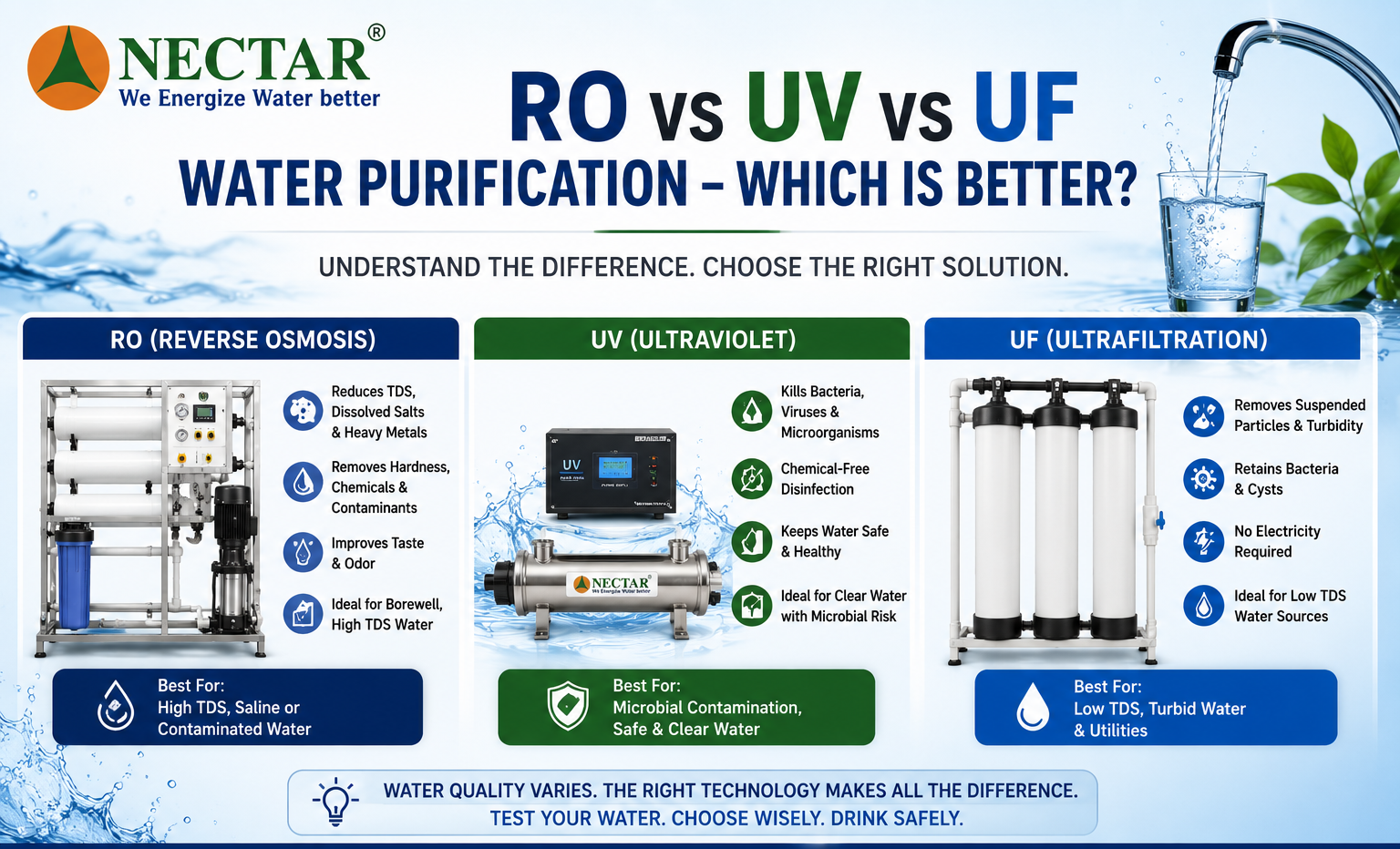
Choosing the right water purifier can be confusing, especially when you come across technologies such as RO, UV, and UF. Each purification method works differently, and each one targets specific water-quality problems. Therefore, the answer to RO vs UV vs UF Water Purification – Which Is Better? depends mainly on your water source and its contamination level.
For example, RO is generally useful for water containing high levels of dissolved salts, while UV targets microorganisms. UF, on the other hand, physically filters many suspended particles and microorganisms without electricity in many configurations. Consequently, understanding these differences will help you choose a suitable purifier for your home or business.
What Is RO Water Purification?
Reverse Osmosis (RO) is a membrane-based purification technology. During the process, pressure forces water through a semi-permeable membrane. The membrane separates a significant portion of dissolved salts and many other contaminants from the treated water.
Therefore, RO is particularly useful when source water has high TDS or salinity.
Reverse Osmosis (RO) is a membrane-based purification technology. During the process, pressure forces water through a semi-permeable membrane. The membrane separates a significant portion of dissolved salts and many other contaminants from the treated water.
Therefore, RO is particularly useful when source water has high TDS or salinity.
What Does RO Help Reduce?
Depending on membrane performance and system design, RO can reduce:
- Total Dissolved Solids (TDS)
- Dissolved salts
- Hardness-causing minerals
- Many dissolved metals
- Chlorides and sulphates
- Various dissolved contaminants
Moreover, a properly designed RO system may include sediment filtration, activated carbon filtration, and other pretreatment stages.
Advantages of RO Purification
RO provides several benefits:
- Significantly reduces TDS
- Treats many dissolved contaminants
- Improves the taste of high-TDS water
- Suitable for many borewell and brackish-water applications
- Available for domestic and commercial use
However, RO systems produce a reject stream and usually require electricity and regular maintenance.
What Is UV Water Purification?
Ultraviolet (UV) purification uses germicidal ultraviolet light to inactivate susceptible microorganisms in water.
As water passes through a UV chamber, UV light damages the genetic material of microorganisms. Consequently, they lose their ability to reproduce.
Unlike RO, however, UV does not significantly reduce dissolved salts or TDS.
What Does UV Treatment Target?
UV treatment primarily addresses microbial contamination, including susceptible:
- Bacteria
- Viruses
- Other microorganisms
Therefore, UV works best when the water is relatively clear because suspended particles and turbidity can interfere with effective UV exposure.
UV systems offer several benefits:
- Chemical-free disinfection
- Fast treatment
- Does not significantly alter taste
- No RO-style reject-water stream
- Suitable for microbiologically unsafe but otherwise appropriate water
However, UV does not physically remove dissolved salts or suspended particles. Therefore, pretreatment may be necessary.
What Is UF Water Purification?
Ultrafiltration (UF) uses a membrane with pores that physically separate suspended particles and many microorganisms from water.
Unlike RO, UF does not require high pressure in many household systems. Moreover, many UF purifiers can operate without electricity.
However, UF does not significantly reduce dissolved salts or TDS.
What Can UF Remove?
UF membranes can help reduce:
- Suspended particles
- Turbidity
- Many bacteria
- Some microorganisms and larger contaminants
However, dissolved salts generally pass through UF membranes.
Therefore, UF is more suitable when the water has relatively acceptable dissolved mineral levels but needs additional physical filtration.
RO vs UV vs UF Water Purification: Key Differences
| Feature | RO | UV | UF |
|---|---|---|---|
| Main technology | Semi-permeable membrane | Ultraviolet light | Ultrafiltration membrane |
| Reduces high TDS | Yes | No | No |
| Reduces dissolved salts | Yes | No | No |
| Targets microorganisms | Yes, as part of a properly designed system | Yes, primary function | Physically retains many microorganisms |
| Removes suspended particles | With suitable filtration stages | No | Yes |
| Electricity | Usually required | Required | Often not required |
| Reject water | Yes | No | Usually minimal/no RO-style reject stream |
| Best suited for | High-TDS / saline water | Microbial disinfection | Low-TDS water needing physical filtration |
Therefore, no technology is universally better. The correct choice depends on what needs to be removed from your water.
When Should You Choose an RO Purifier?
Consider an RO purifier when water testing indicates high levels of dissolved salts or contaminants that an appropriate RO membrane can reduce.
RO may be suitable when:
- Borewell water has high TDS
- Water tastes excessively salty
- Dissolved mineral content is high
- Specific dissolved contaminants require reduction
- The application requires lower-TDS treated water
However, you should not choose RO solely because it is considered a more advanced technology. If the source water already has suitable mineral content, another treatment approach may be more appropriate.
When Should You Choose a UV Purifier?
UV treatment is useful when microbiological contamination is the primary concern and the source water is clear enough for effective UV transmission.
For example, UV can provide an additional disinfection barrier in appropriately pretreated water systems.
Therefore, UV may be suitable for:
- Microbial disinfection
- Drinking-water treatment systems
- RO post-treatment
- Commercial water purification
- Water-treatment plants
However, UV cannot solve high-TDS, hardness, or dissolved-salt problems.
UF is useful when you need physical filtration but do not need significant TDS reduction.
Therefore, UF may be considered when:
- TDS levels are already suitable
- Water contains suspended impurities
- Additional membrane filtration is required
- A non-electric filtration option is preferred
Moreover, UF can form part of a multi-stage purification system alongside other treatment technologies.
Combining RO, UV, and UF can provide multiple treatment barriers. However, more stages do not automatically mean better water.
A combined system may use:
Sediment Filter → Activated Carbon → RO → UV/UF → Post-Treatment
Each stage performs a different function. For example, RO reduces dissolved salts, while UV provides microbial disinfection. UF may provide an additional physical barrier.
Nevertheless, the exact configuration should depend on source-water testing and the desired treated-water quality.
Therefore, avoid selecting a purifier based only on the number of purification stages advertised.
Borewell water quality varies significantly from one location to another.
It may contain:
- High TDS
- Hardness
- Iron
- Manganese
- Suspended particles
- Microbial contamination
If borewell water has high TDS, RO may be appropriate. However, if the same water contains significant iron, an Iron Removal Plant or suitable pretreatment system may be required before RO.
Similarly, very hard water may require additional pretreatment depending on the RO design.
Therefore, a water test should always come before equipment selection.
Municipal water is generally treated before distribution, but its quality can vary because of storage tanks, pipelines, and local conditions.
If TDS is within an appropriate range and dissolved contamination is not a concern, UV or UF-based treatment may sometimes be sufficient.
However, the correct choice still depends on testing rather than the source name alone.
The best drinking-water purifier is one that addresses the contaminants actually present in your water.
Before choosing between RO, UV, and UF, test important parameters such as:
- TDS
- pH
- Hardness
- Iron
- Turbidity
- Chloride
- Fluoride where relevant
- Microbiological quality
- Other locally relevant contaminants
Consequently, you can choose a purification system based on evidence instead of assumptions.
Every purifier needs maintenance to provide consistent performance.
RO Maintenance
RO systems may require:
- Sediment-filter replacement
- Carbon-filter replacement
- Membrane monitoring/replacement
- System sanitization
- Pump and pressure checks
UV Maintenance
UV systems require:
- UV lamp replacement according to manufacturer guidance
- Quartz sleeve cleaning
- Periodic system inspection
UF Maintenance
UF systems may require:
- Membrane cleaning or flushing
- Prefilter replacement
- Periodic sanitization
Therefore, maintenance costs should also be considered when selecting a purifier.
The simplest answer is:
Choose RO when dissolved salts and high TDS are the main problems. Choose UV when microbial disinfection is required. Choose UF when you need physical filtration of suspended particles and many microorganisms without significant TDS reduction.
In some situations, a combination provides the most appropriate treatment.
Therefore, there is no universal winner in the RO vs UV vs UF Water Purification comparison.
When comparing RO vs UV vs UF Water Purification – Which Is Better?, the right answer depends on your source-water quality.
RO is particularly useful for reducing TDS and dissolved salts. UV provides chemical-free microbial disinfection, while UF physically filters suspended particles and many microorganisms without significantly reducing TDS.
Therefore, conduct a professional water-quality test before selecting a purifier. Once you understand the levels of TDS, hardness, iron, turbidity, and microbial contamination, you can choose an RO, UV, UF, or combination system that delivers safe and appropriate water without unnecessary treatment.