Why Industrial RO Plants Are Essential for Modern Industries
Water plays a critical role in almost every industrial process. Whether it is manufacturing, food processing, pharmaceuticals, textiles, power generation, or chemical production, high-quality water is essential for maintaining efficiency and product quality. However, raw water often contains dissolved salts, minerals, chemicals, bacteria, and other contaminants that can affect industrial operations.
Therefore, industries increasingly rely on Industrial Reverse Osmosis (RO) Plants to produce purified water and protect valuable equipment. Moreover, Industrial RO Plants help businesses reduce operating costs, improve productivity, and meet environmental regulations.
As a result, Industrial RO technology has become one of the most preferred water treatment solutions worldwide.
What Is an Industrial RO Plant?
An Industrial Reverse Osmosis (RO) Plant is an advanced water purification system designed to remove dissolved solids, salts, chemicals, heavy metals, bacteria, viruses, and other contaminants from water.
The system uses a semi-permeable membrane that allows only pure water molecules to pass through while rejecting impurities.
Consequently, industries receive high-quality purified water suitable for production processes, boiler feed applications, cooling systems, and various manufacturing operations.
How Does an Industrial RO Plant Work?
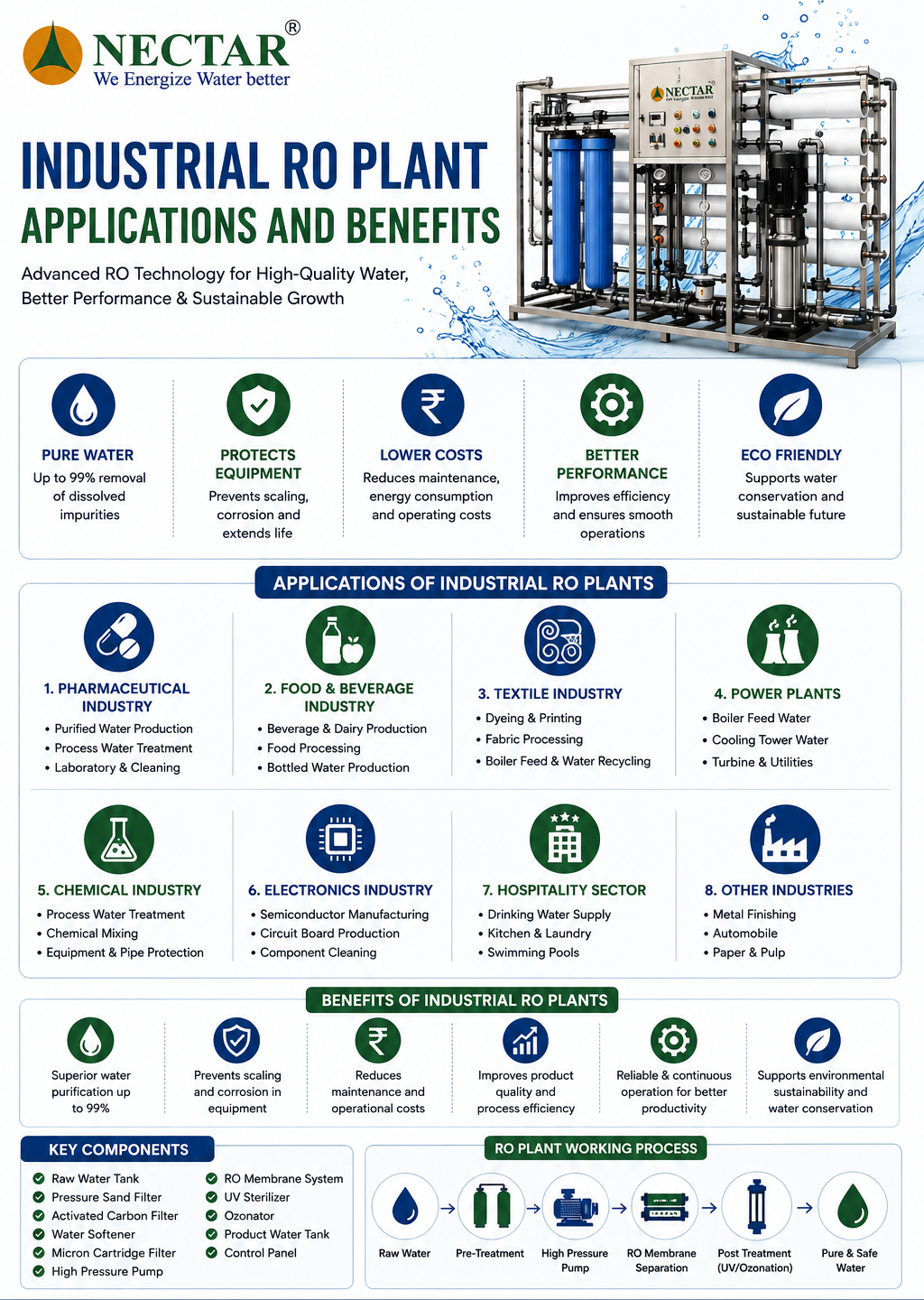
Industrial RO Plants use a multi-stage purification process to ensure maximum water quality.
Pre-Treatment Stage
Initially, raw water passes through:
- Pressure Sand Filters
- Activated Carbon Filters
- Water Softeners
- Micron Cartridge Filters
As a result, suspended particles, chlorine, and organic contaminants are removed before reaching the RO membrane.
Reverse Osmosis Process
Next, a high-pressure pump forces water through the RO membrane.
Consequently:
- Dissolved salts are removed
- Heavy metals are rejected
- Harmful chemicals are filtered out
- Bacteria and viruses are eliminated
Post-Treatment Stage
Finally, purified water may undergo:
- UV Sterilization
- Ozonation
- pH Adjustment
Therefore, the water becomes suitable for industrial applications.
Applications of Industrial RO Plants
Because industries require high-purity water, Industrial RO Plants are widely used across various sectors.
1. Pharmaceutical Industry
The pharmaceutical industry requires ultra-pure water for manufacturing medicines, syrups, injections, and healthcare products.
Therefore, Industrial RO Plants help maintain strict quality standards and regulatory compliance.
Applications:
- Purified Water Production
- Process Water Treatment
- Laboratory Water Supply
- Pharmaceutical Manufacturing
2. Food and Beverage Industry
Water quality directly impacts food safety and product quality.
Consequently, food and beverage manufacturers use RO systems to ensure safe and contamination-free water.
Applications:
- Beverage Production
- Dairy Processing
- Food Manufacturing
- Bottled Water Production
3. Textile Industry
The textile sector consumes large amounts of water during dyeing, washing, and finishing processes.
Therefore, RO Plants help improve production quality while reducing water contamination.
Applications:
- Dyeing Operations
- Fabric Processing
- Water Recycling
- Boiler Feed Water
4. Power Plants
Power generation facilities require high-quality water for boilers and cooling systems.
Because dissolved minerals can cause scaling and corrosion, RO treatment becomes essential.
Applications:
- Boiler Feed Water
- Cooling Tower Water
- Turbine Operations
- Water Reuse Systems
5. Chemical Industry
Chemical manufacturing processes demand purified water to maintain product consistency and equipment protection.
Consequently, Industrial RO Plants play a vital role in process efficiency.
Applications:
- Process Water Treatment
- Chemical Mixing
- Equipment Protection
- Water Recycling
6. Electronics Industry
The electronics sector requires ultra-pure water for manufacturing sensitive electronic components.
Therefore, RO Plants help prevent contamination and ensure product quality.
Applications:
- Semiconductor Manufacturing
- Circuit Board Production
- Component Cleaning
- Precision Manufacturing
7. Hospitality Sector
Hotels, resorts, and large commercial facilities require clean water for guests and operational purposes.
As a result, Industrial RO Plants provide reliable water purification for hospitality businesses.
Applications:
- Drinking Water Supply
- Kitchen Operations
- Laundry Services
- Swimming Pools
Benefits of Industrial RO Plants
Superior Water Purification
Industrial RO systems remove up to 99% of dissolved impurities, salts, and contaminants.
Therefore, industries receive consistently high-quality water.
Reduced Equipment Scaling
Because RO treatment removes hardness-causing minerals, scale formation is minimized.
Consequently:
- Equipment efficiency improves
- Maintenance costs decrease
- Equipment lifespan increases
Lower Operating Costs
Industrial RO Plants reduce:
- Equipment repair costs
- Energy consumption
- Chemical usage
- Water wastage
As a result, businesses achieve significant long-term savings.
Improved Product Quality
Water quality directly influences production quality.
Therefore, purified water helps manufacturers maintain consistent product standards and customer satisfaction.
Environmental Sustainability
Modern Industrial RO Plants support water conservation and wastewater reduction.
Consequently, industries can meet environmental regulations while reducing their environmental impact.
Reliable Continuous Operation
Industrial RO systems are designed for continuous operation under demanding conditions.
Therefore, industries benefit from uninterrupted water supply and improved productivity.
Key Components of an Industrial RO Plant
A standard Industrial RO Plant includes:
- Raw Water Tank
- Raw Water Pump
- Pressure Sand Filter
- Activated Carbon Filter
- Water Softener
- Micron Cartridge Filter
- High-Pressure Pump
- RO Membrane System
- UV Sterilizer
- Ozonator
- Product Water Tank
- Electrical Control Panel
As a result, the system delivers efficient and reliable water purification.
Why Industries Prefer RO Technology
Compared to conventional treatment methods, RO technology offers:
- Higher purification efficiency
- Lower maintenance requirements
- Better water quality
- Reduced operational costs
- Longer equipment life
- Greater process reliability
Therefore, RO technology remains the preferred choice for industrial water treatment applications.
Conclusion
Industrial RO Plants have become an essential part of modern industrial operations. By removing dissolved salts, minerals, chemicals, and contaminants, these systems provide high-quality water for various manufacturing and processing applications.
Moreover, Industrial RO Plants improve equipment performance, reduce maintenance costs, enhance product quality, and support environmental sustainability. Therefore, investing in a reliable Industrial RO Plant is a smart decision for industries seeking efficient and cost-effective water treatment solutions.
With proper design, installation, and maintenance, Industrial RO systems deliver long-term benefits and help businesses achieve operational excellence.