Best Water Filter for Iron-Rich Water: Complete Guide for Clean and Clear Water
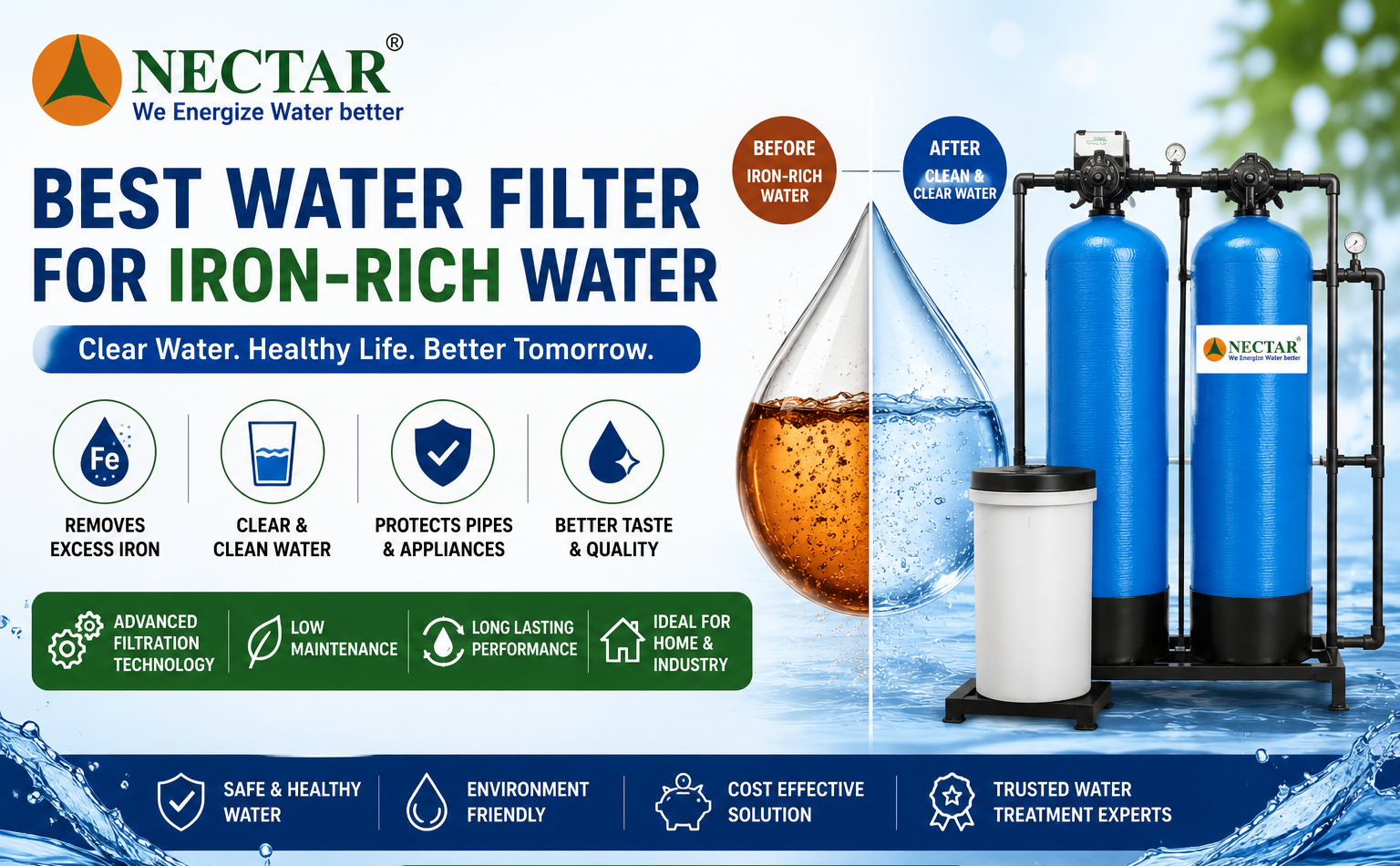
Iron-rich water is a common problem in homes, apartments, commercial buildings, and industries that depend on borewell or groundwater. Although iron occurs naturally in groundwater, excessive levels can turn water yellow or brown, create a metallic taste, stain bathroom fixtures, and cause deposits inside plumbing systems. Therefore, choosing the Best Water Filter for Iron-Rich Water is essential for maintaining better water quality.
However, not every water filter removes iron effectively. The right treatment depends on the type and concentration of iron, pH, manganese, turbidity, and other characteristics of the source water. Consequently, testing the water before selecting a filtration system can help you achieve reliable, long-term results.
Why Does Borewell Water Contain Iron?
Iron naturally occurs in soil, rocks, and underground mineral deposits. As groundwater moves through these layers, it can dissolve iron before entering a borewell.
Initially, dissolved iron may remain invisible. However, when the water comes into contact with oxygen, the iron can oxidize and form yellow, orange, or reddish-brown particles.
Moreover, corroded pipelines and storage tanks can sometimes add iron to the water supply. Therefore, identifying the source of contamination is an important first step.
Common Signs of Iron-Rich Water
You may need a water filter for iron-rich water if you notice:
- Yellow, orange, or brown water
- Metallic taste
- Reddish-brown stains on toilets and washbasins
- Stains on bathroom tiles and fittings
- Brown marks on washed clothes
- Sediment inside water tanks
- Deposits around taps and showerheads
- Reduced water flow in pipelines
Therefore, persistent staining or discoloration should prompt a proper water-quality test.
Types of Iron Found in Water
Before choosing the Best Water Filter for Iron-Rich Water, it helps to understand the different forms of iron.
Before choosing the Best Water Filter for Iron-Rich Water, it helps to understand the different forms of iron.
Ferrous Iron
Ferrous iron is dissolved in water. Therefore, the water may initially look clear.
However, after exposure to air, oxidation can cause reddish or brown particles to form.
Ferric Iron
Ferric iron is already oxidized. Consequently, the water may contain visible orange, red, or brown particles.
Filtration can often remove these suspended particles when the system is properly designed.
Iron Bacteria
Iron bacteria use iron in water and can produce slimy deposits in pipes, pumps, and tanks. They may also contribute to unpleasant odours and operational problems.
Therefore, iron bacteria can require a different treatment approach than dissolved iron alone.
What Is the Best Water Filter for Iron-Rich Water?
There is no single filter that works best for every water source. However, for significant iron contamination, a properly designed Iron Removal Plant (IRP) is often a more suitable solution than relying on a basic cartridge filter.
A typical iron removal process may use oxidation followed by specialized filtration. First, the system converts dissolved iron into particles. Next, suitable filter media capture those particles. Finally, treated water flows to the storage or distribution system.
As a result, the treatment can significantly reduce iron-related staining, discoloration, and deposits.
How Does an Iron Removal Filter Work?
A typical iron removal system works through several stages.
1. Oxidation
First, dissolved ferrous iron must be converted into an oxidized form that filtration can remove.
Depending on the water chemistry and system design, oxidation may use air or an appropriate oxidizing process.
2. Filtration
Next, water passes through suitable filtration media. The media capture oxidized iron particles and other suspended impurities.
Consequently, the treated water becomes clearer.
3. Backwashing
Over time, trapped iron accumulates in the filter bed. Therefore, many iron removal systems require regular backwashing to flush these particles away and restore filtration performance.
This process helps the system provide consistent treatment over the long term.
A Pressure Sand Filter can help remove suspended and previously oxidized iron particles. It also reduces sand, dirt, and turbidity.
However, it may not effectively remove significant amounts of dissolved ferrous iron without suitable oxidation or pretreatment.
Therefore, the complete treatment process should match the water chemistry rather than relying on a sand filter alone.
Can an Activated Carbon Filter Remove Iron?
Activated carbon filters are highly useful for improving certain aspects of water quality, including taste, odour, chlorine, and some organic compounds.
However, standard activated carbon is generally not the primary treatment for high dissolved iron concentrations.
Consequently, activated carbon may work as an additional treatment stage after iron removal rather than replacing a dedicated iron removal system.
Can an RO Purifier Remove Iron?
Reverse Osmosis membranes can reject many dissolved substances, including some dissolved metals. However, directly feeding iron-rich borewell water into an RO purifier can create membrane fouling and reduce system performance.
Therefore, if your source water contains significant iron, proper iron removal pretreatment before RO is usually preferable.
A treatment sequence may look like:
Borewell Water → Iron Removal System → Additional Pretreatment → RO System → Treated Water
The exact configuration should depend on laboratory test results.
Benefits of Installing an Iron Removal Filter
Choosing an appropriate iron removal system can provide several practical advantages.
It can:
- Reduce iron concentration
- Improve water clarity
- Reduce yellow and brown discoloration
- Minimize reddish-brown stains
- Improve water taste where iron causes metallic flavour
- Protect plumbing from iron deposits
- Reduce deposits in storage tanks
- Protect downstream filters and RO membranes
- Reduce cleaning requirements
- Improve overall water usability
As a result, a well-designed iron removal system can protect both your water supply and your property.
Best Water Filter for Iron-Rich Borewell Water
For borewell water, treatment should always begin with testing.
Important parameters include:
- Total iron
- Ferrous and ferric iron, where relevant
- Manganese
- pH
- Turbidity
- Total hardness
- TDS
- Microbiological quality
For example, water containing mainly dissolved iron may require oxidation followed by filtration. However, water containing iron, high hardness, high TDS, and microbial contamination may require several treatment stages.
Therefore, a customized system usually performs better than choosing equipment based only on visible water colour.
Residential Iron Removal Systems
Homes using borewell water can install a centralized iron removal system before water enters the main household distribution network.
This approach can help protect:
- Bathroom fittings
- Washing machines
- Water heaters
- Pipelines
- Storage tanks
- Downstream water purifiers
Moreover, treating water centrally ensures that multiple taps receive improved-quality water instead of treating only drinking water.
Hotels, hospitals, apartments, schools, manufacturing units, and other facilities often require higher treatment capacities.
Therefore, commercial iron removal systems can be designed according to:
- Water consumption
- Peak flow rate
- Iron concentration
- Source-water chemistry
- Required treated-water quality
- Available installation space
Furthermore, automatic valves and backwashing controls can simplify operation for larger installations.
Before purchasing a system, consider the following factors:
- Test your water: Determine iron, manganese, pH, hardness, TDS, turbidity, and other relevant parameters.
- Identify the iron type: Dissolved and particulate iron may require different treatment stages.
- Calculate water demand: Choose a system capable of handling both daily consumption and peak flow.
- Check filtration technology: Select suitable oxidation and filtration methods for your water chemistry.
- Consider maintenance: Understand backwashing, media replacement, and servicing requirements.
- Plan for future treatment: If you also need softening or RO, design the pretreatment stages accordingly.
Therefore, professional system sizing is essential for consistent performance.
Even the best iron filter requires regular maintenance.
For reliable performance:
- Backwash the system at the recommended frequency.
- Inspect valves and piping.
- Monitor treated-water quality.
- Clean storage tanks periodically.
- Replace or replenish filter media when required.
- Test source water periodically because groundwater quality can change.
Consequently, preventive maintenance helps maintain filtration efficiency and extends equipment life.
Visible brown water can indicate iron, but appearance alone cannot determine the exact treatment requirement. Manganese, sediments, corrosion, and other contaminants can produce similar symptoms.
Therefore, professional testing prevents you from investing in the wrong filtration technology.
Moreover, laboratory results allow water-treatment professionals to determine the appropriate system capacity, filtration media, oxidation method, and additional treatment stages.
Choosing the Best Water Filter for Iron-Rich Water depends on much more than selecting a standard household filter. If your borewell water contains significant dissolved iron, a properly designed Iron Removal Plant using suitable oxidation and filtration is often an effective long-term solution.
However, the best treatment depends on your actual water quality. Therefore, test the water for iron, manganese, pH, hardness, TDS, turbidity, and other relevant parameters before installing a system.
With the correct iron removal solution, you can reduce yellow or brown water, prevent rust-coloured stains, protect plumbing and appliances, and enjoy clearer water throughout your property.