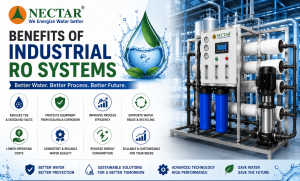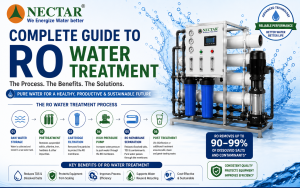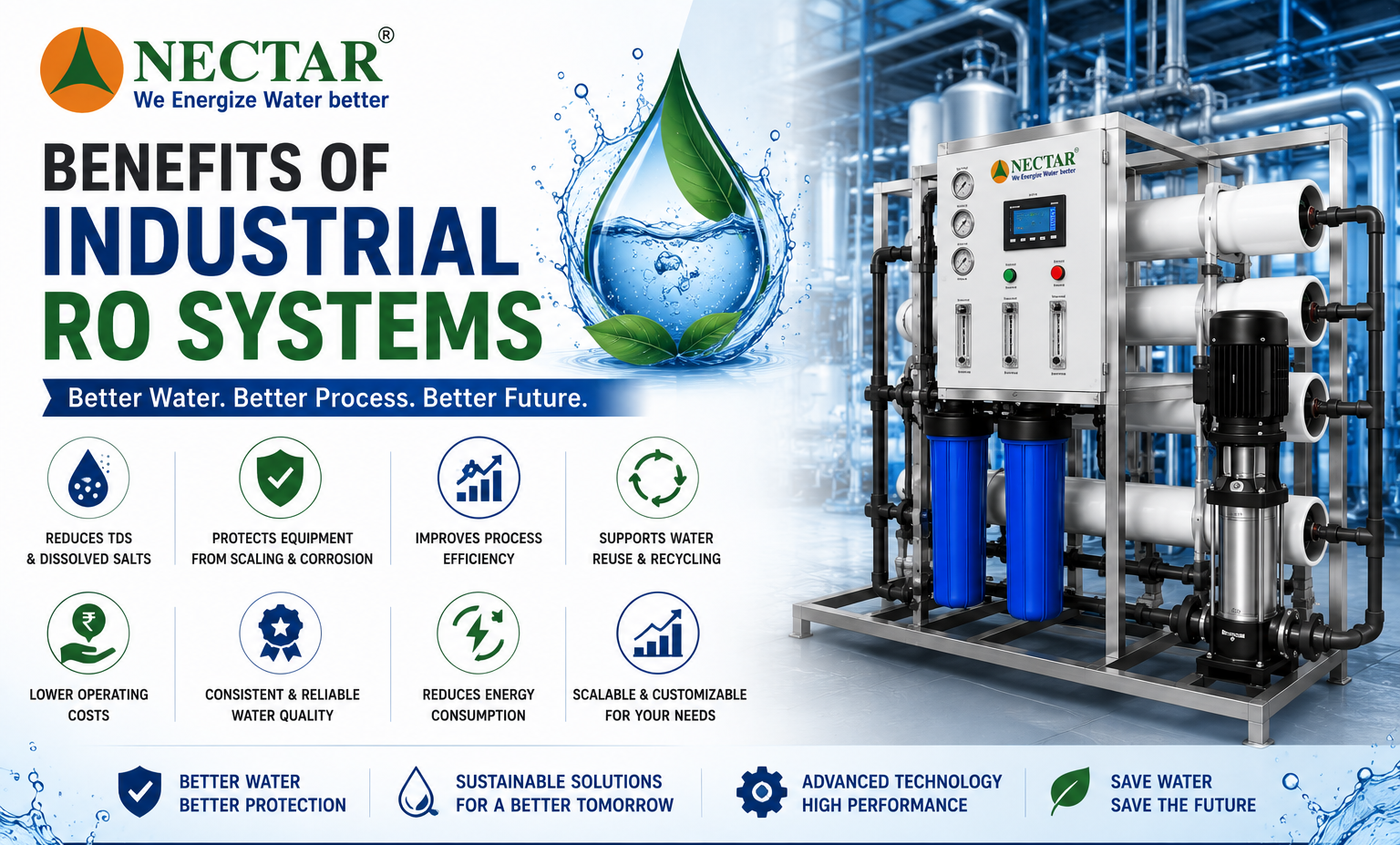
Benefits of Industrial RO Systems
Industrial facilities require consistent water quality for manufacturing, processing, cleaning, cooling, boilers, laboratories, and many other operations. However, untreated water may contain dissolved salts, hardness minerals, metals, and other impurities that can affect equipment and production processes. Therefore, installing an Industrial Reverse Osmosis (RO) System can provide an effective solution for many water-treatment requirements.
The Benefits of Industrial RO Systems include improved process-water quality, reduced dissolved solids, better equipment protection, consistent production, and opportunities for water reuse. Moreover, modern RO plants can be designed according to source-water quality, required capacity, and industry-specific requirements.
What Is an Industrial RO System?
An Industrial RO System is a membrane-based water treatment plant designed to reduce dissolved salts and many other dissolved contaminants from water.
During reverse osmosis, a high-pressure pump forces pretreated water through semi-permeable membranes. Consequently, the membrane separates the feed stream into purified water, known as permeate, and a concentrated reject stream.
Industrial RO plants can treat water from sources such as:
- Borewell water
- Groundwater
- Municipal supply
- Brackish water
- Appropriately pretreated process water
- Appropriately treated wastewater for reuse applications
Therefore, RO technology offers a flexible solution for many industrial water-treatment needs.
1. Reduces Total Dissolved Solids (TDS)
One of the primary benefits of industrial RO systems is their ability to significantly reduce Total Dissolved Solids (TDS).
Depending on membrane selection, feed-water chemistry, and operating conditions, RO can reduce many dissolved substances, including salts and hardness-related ions.
As a result, industries receive water with more consistent dissolved-solids levels for their processes.
Furthermore, lower TDS can help reduce mineral-related problems in downstream equipment.
2. Provides Consistent Process Water Quality
Many manufacturing processes require water with controlled and consistent quality. Variations in raw-water chemistry can affect product quality and equipment performance.
Therefore, a properly designed industrial RO plant helps maintain more predictable treated-water characteristics.
Consistent process water is particularly important in sectors such as:
- Pharmaceuticals
- Food and beverages
- Electronics
- Chemicals
- Textiles
- Automotive manufacturing
- Power generation
Consequently, better water consistency can support more stable production conditions.
3. Protects Industrial Equipment
Hardness minerals and dissolved salts can contribute to deposits, scaling, and corrosion-related problems in industrial systems.
Therefore, reducing appropriate dissolved contaminants before water reaches sensitive equipment can help protect:
- Boilers
- Heat exchangers
- Cooling systems
- Process pipelines
- Cleaning systems
- Manufacturing machinery
As a result, an industrial RO system can form an important part of a broader equipment-protection strategy.
4. Helps Reduce Scaling
Scaling can occur when dissolved minerals become concentrated and precipitate on equipment surfaces.
Consequently, scale can reduce heat-transfer efficiency, restrict water flow, and increase maintenance requirements.
RO treatment reduces many dissolved ions before the water reaches downstream equipment. Therefore, it can help lower scaling potential when combined with appropriate pretreatment and system design.
However, RO membranes themselves also require scale control. For this reason, proper pretreatment remains essential.
Boilers require carefully controlled feed-water quality because dissolved salts and hardness can contribute to scale formation and other operational problems.
Industrial RO systems are frequently incorporated into boiler-water treatment processes because they reduce a significant proportion of dissolved minerals.
As a result, properly treated feed water may help:
- Reduce scaling potential
- Improve boiler-water management
- Reduce blowdown requirements in suitable systems
- Support more efficient heat transfer
- Protect downstream treatment equipment
However, additional treatment may be required depending on boiler pressure and feed-water specifications.
6. Improves Water Quality for Manufacturing
Water can directly influence the quality of finished products.
For example, industries producing beverages, pharmaceuticals, chemicals, cosmetics, and other sensitive products may require carefully controlled water quality.
Therefore, industrial RO systems help provide a consistent foundation for further purification or direct process use where appropriate.
Moreover, RO can be combined with technologies such as UV disinfection, ultrafiltration, demineralization, electrodeionization, or other polishing processes when higher-quality water is required.
7. Supports Water Reuse and Recycling
Water conservation has become increasingly important for industries.
With appropriate upstream treatment, RO technology can form part of a wastewater-recycling system. For example, wastewater may first pass through an Effluent Treatment Plant (ETP) or Sewage Treatment Plant (STP). After suitable pretreatment, RO may further improve water quality for selected reuse applications.
Consequently, treated water may potentially be reused for appropriate purposes such as:
- Cooling applications
- Washing
- Utility requirements
- Process applications
- Other non-potable industrial uses
The actual reuse application should always match the treated-water quality and applicable requirements.
8. Reduces Dependence on Fresh Water
Industries with high daily water consumption may face increasing pressure to manage freshwater resources efficiently.
Therefore, integrating RO into an appropriately designed recycling system can help reduce dependence on fresh-water sources.
Moreover, water reuse can improve overall plant sustainability and help organizations manage water scarcity more effectively.
9. Customizable for Different Industrial Requirements
Industrial water requirements vary significantly between facilities.
Therefore, industrial RO plants can be designed according to:
- Feed-water quality
- Required treated-water quality
- Daily water demand
- Peak flow requirements
- TDS concentration
- Available space
- Desired automation level
- Pretreatment requirements
- Recovery objectives
Consequently, systems can range from relatively compact commercial installations to large industrial treatment plants.
10. Automated Operation and Monitoring
Modern industrial RO systems can incorporate automation to simplify plant operation.
Depending on the design, monitoring can include:
- Feed pressure
- Membrane pressure
- Permeate flow
- Reject flow
- Conductivity or TDS
- Tank levels
- Chemical dosing
- System alarms
Furthermore, automated controls can help operators identify abnormal conditions quickly.
As a result, facilities can maintain more consistent performance while reducing unnecessary manual intervention.
An appropriately designed RO system can improve water-management efficiency across industrial operations.
For example, better-quality water may reduce mineral deposition in certain equipment, while proper automation can simplify monitoring and operation.
Furthermore, optimized recovery can help facilities balance treated-water production and reject-water generation.
However, efficiency depends heavily on feed-water chemistry, membrane configuration, pretreatment, operating pressure, and maintenance.
Therefore, professional system design is essential.
One major advantage of industrial RO technology is scalability.
As production requirements increase, businesses may need additional treated-water capacity. Depending on the original system design, additional membrane trains or treatment modules can sometimes be incorporated.
Consequently, companies can plan water-treatment infrastructure around current requirements while considering future expansion.
RO membranes are highly effective, but they are sensitive to certain contaminants.
Therefore, suitable pretreatment is essential for maintaining reliable performance.
Depending on raw-water quality, pretreatment may include:
- Pressure Sand Filter
- Multi Grade Filter
- Activated Carbon Filter
- Iron Removal Plant
- Water Softener
- Micron Cartridge Filter
- Antiscalant dosing
- pH adjustment
- Ultrafiltration
For example, borewell water containing high iron may require iron removal before RO. Similarly, water with significant scaling potential may require suitable scale-control measures.
As a result, proper pretreatment can reduce membrane fouling and improve plant reliability.
Because RO technology is versatile, it is used across numerous industries, including:
- Food and Beverage
- Pharmaceutical
- Textile
- Automobile
- Chemical
- Electronics
- Hospitals
- Hotels
- Power Plants
- Manufacturing Facilities
- Commercial Buildings
- Educational Institutions
- Process Industries
However, each industry has different water-quality requirements. Therefore, system specifications should be customized for the intended application.
Regular maintenance is essential for achieving the long-term benefits of an Industrial RO System.
Operators should regularly monitor:
- Feed and permeate TDS
- Operating pressure
- Permeate flow
- Reject flow
- Recovery rate
- Filter pressure drop
- Chemical dosing
- Membrane performance
Furthermore, cartridge filters should be replaced when required, while RO membranes should be cleaned based on performance data and manufacturer recommendations.
Consequently, preventive maintenance can reduce unexpected downtime and maintain consistent water production.
Before purchasing an Industrial RO Plant, start with a complete raw-water analysis.
Next, determine your:
- Daily water requirement
- Peak flow demand
- Feed-water TDS
- Required treated-water quality
- Industrial application
- Pretreatment needs
- Available installation space
- Automation requirements
Moreover, consider operating costs, maintenance requirements, reject-water management, and future expansion.
Therefore, choosing an RO system based only on capacity or price may not provide the best long-term results.
The Benefits of Industrial RO Systems extend beyond simply reducing TDS. A properly designed RO plant can provide consistent process water, reduce dissolved salts, support equipment protection, improve water-management efficiency, and form part of an industrial water-reuse strategy.
Moreover, modern Industrial RO Systems can be customized for different capacities, source-water conditions, and industry-specific requirements.
However, successful RO operation depends on professional water testing, effective pretreatment, correct system design, and preventive maintenance. Therefore, industries should evaluate their source water and required treated-water quality before selecting an RO plant.
With the right treatment configuration, an Industrial RO System can provide dependable water quality and support efficient, sustainable industrial operations for years to come.